Gaunt’s Ghosts
Salvation’s Reach is the latest book in the Gaunt’s Ghosts series of novels. As a review of one book in series of thirteen would be a bit useless to those of you who’ve aren’t familar with them, let’s take a quick look at the series as a whole.
The books are set in the Warhammer 40,000 setting, and focuses on the fate of a specific regiment of Imperial Guardsmen; The Tanith First and Only. These are just regular guys, armed with fairly standard equipment and weapons, facing an uncaring galaxy filled with hostile monsters and hidden horror. They are humble riflemen, doing their duty to protect their civilisation, with very little hope of long term survival. Those familiar with the Sharpe series may recognise some elements here; the first few stories were pitched as ‘Sharpe in Space’. It’s a fair summary, though not a very descriptive one. The two are very different from each other in many respects, however, both are character-lead action dramas with high body counts.
The series began life as a collection of short stories in the magazine Inferno1, and this means they tend to have an episodic nature. This is actually rather handy, as it means you can digest the stories in bite-sized chunks. (I recommend reading them on an e-reader whilst travelling). You can put them down for a while, but the stories are deeply more-ish.
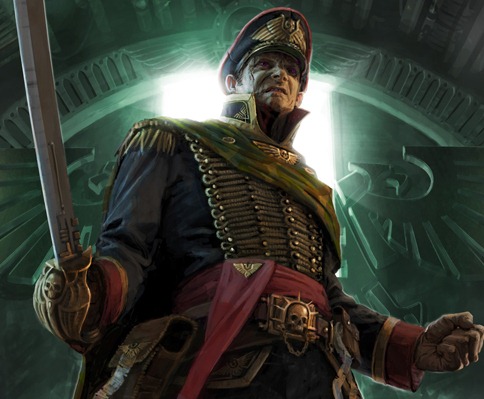
Grim. Dark. Gothic. And a page turner. Stock up on them for a long journey.
The earlier books in the series (collected together in an anthology called The Founding) are also the weakest, but no less interesting. As the first anthology concludes, you can tell that the author, Dan Abnett, is just starting to get into the swing of things. The writing begins with at a pretty good quality, but as the series progresses, the narrative gets much better and becomes much more fun. It’s intensely satisfying to see an author whom you like to begin with improve, and the Gaunt’s Ghosts delivers this in spades. Each anthology improves on the other, as we learn more about the world they are in and the people that surround the regiment.
As this is a tale of war and warriors, the body count is very high. Abnett fiendishly keeps key characters around long enough for you to become familiar and fond of them. He’ll hint at dark fates for his characters (after all, this is a war story), and just when you think your favourites are safe, something awful happens to them. It’s part of the fun. The churn of shocks, bluffs, revelations and funerals are the life-blood of this series. As you become more convinced of the indomitability of certain heroes, something happens to change everything. It’s grim. It’s dark. But it’s also about people surviving in extraordinary ways. Gaunt’s Ghosts is a series about heroes, but flawed, fractured heroes who keep going. “Only in death does duty end” as the books so succinctly put it.
So what about Salvation’s Reach ? More shocks, more revelations. More people die and we learn more about the world. Is it the same as the last dozen? Not a bit of it, because part of the appeal of the series is it uses the massive galaxy it’s set in as a backdrop to the drama. Did I devour it during the spare moments? Of course I did, it’s what I’ve come to expect from the series. Did it leave me wanting more? Yes. More please.
1: An ambitious short story magazine, with a focus on the Warhammer and Warhammer 40K worlds. Sadly, like many anthology periodicals, it’s no longer around. However, the same people behind Inferno do produce a regular e-zine called Hammer and Bolter, which fulfils the same sort of purpose. Which is good, as short story anthologies allow both readers and publishers to find new talent.
BANDIT!
Christmas is coming, a geeks everywhere are wondering if there is a slightly odd present that they can give to a loved one in order to open someone’s world to the wonderful weirdness that we nerds take in our stride.
One of the comic-books I love to give to non-comic fans is Grant Morrison’s We3, which can inaccurately described as Watership Down meets Short Circuit1.
This gripping, intelligently written and beautiful drawn tale is a showcase for the sort of quirky stories that work brilliantly well in the graphic-novel format; a sentimental action story about a bunny rabbit, a dog and a cat on the run from a US military. Why are they on the run? Because they’ve been wired into enormously powerful war-machines. The story begins with an Army commander realising what a terrible idea this was in the first place, and demanding the project be ‘terminated’. One of the scientists can’t bear to hurt the poor wee beasties, and lets them loose instead.

It’s the sort of absurd tale that can only be well realised by the sort of talent working in comics today, in this case, Grant Morrison, who’s well known for his weird stories filled with warmth, emotion and utter freakiness. Morrison has written some very well regarded mainstream comic books in recent years, and his back catalogue is filled with brilliant yet odd stories.2 His best work is always his strangest and We3 is no exception.
Artist Frank Quitely draws the three animals in a way that reminds us that these are the sort of creatures we have as pets. The artwork is always sympathetic and makes us believe that they are innocent creatures trapped in a man-made nightmare, doing what they can to escape. It’s the sort of thing that works well in a comic-book, and though I would love to see We3 on the big screen, I doubt it would have the same sort of impact.
This is a book that will extract a tear and a smile from any but the most hardened of comics reads, and as a way to showcase precisely what the medium can do, it’s ideal. It’s also cheap, and short, and a great stocking-filler.
1: If you’ve not read the novel, Watership Down then you should. It’s one of those books everyone should read. The same cannot be said for the 80’s move Short Circuit, which is not as good as you remember.
2: RomCom pastiche Kill your boyfriend and tabloid parody Big Dave spring to mind. Big Dave featured special envoy Terry Waite punching aliens for justice.
The Nightmare Man
The BBC has a long history of delivering quirky and intelligent drama, be it science-fiction, crime stories, thrillers or something else entirely. One example the springs to mind is 1981 drama The Nightmare Man1 adapted for television by genre hero Robert Holmes 2.
This short, 4-part drama contains all the elements you need for a classic British creepy story; a remote Scottish island, a new arrival and of course, a mystery that needs solving. In this case, a series of bizarre murders, caused by some sort of weird thing. As the cast get bumped off in gruesome ways and more mystery gets stirred into the plot, the tale gets darker and more bizarre with every turn.

The series features familiar faces looking much younger than you're used to
This is classic eighties telly, and proves the point that you don’t need a big budget to achieve a strong story, The Nightmare Man was shot on location in Cornwall with a cast that would be familiar to anyone who’s ever watched something made by the BBC.
Though the pacing is slow (a common feature for dramas made last century), this lends the series a much needed feeling of claustrophobia. The Nightmare Man is just the right size. Too much longer and we’d want to know more and if it was any shorter some viewers would be confused. 3
Fans of spooky stories with a distinctly British edge will enjoy this. If you’re a fine of the likes of Steven Moffat or Warren Ellis, I’m confident that’ll you get a kick out of this.
1: Based on a book called the Child of Vodyanoi by David Wiltshire. The story is apparently inspired by the Howard Hawk’s 1951 movie The Thing from Another World; the same movie which inspired both John Carpenter’s The Thing and Ridley Scott’s Alien. Or to put it another way, the story has an excellent heritage.
2: Robert Holmes wrote some of the more popular and well-known episodes of Doctor Who, including Spearhead in Space, which introduced us to John Pertwee as the third Doctor and the Autons and The Talons of Weng Chiang, which gave us Tom Baker in a deer-stalker doing a Sherlock Holmes impersonation. Holmes also wrote scripts for police drama, Juliet Bravo.
3: TV Tropes calls this British Brevity. If you’ve never seen the TV Tropes website before, I should warn you that it’s a massive time sink.
Robert Kirkman’s Invincible
Robert Kirkman is best known for his comic book turned TV series The Walking Dead. What a number of zombie-horror fans neglect is Kirkman’s just as lengthy and detailed work Invincible. This is isn’t that much of a suprise; horror comics stand out more amongst the countless super-hero books on the market, and on first glance, it’s pretty easy to dismiss it as just another super-hero book.
The set-up for Invincible is surprisingly simple; it’s a mix of the growing pains angst that fans of various Spider-Man titles will be familiar with and the sort of two-fisted, god-like heroism that appears all the time in books like Superman. The titular character is a young man with incredible power and a sudden realisation that he’d better find some sense of responsibility or deal with the consequences. The book addresses the notion that if one was nearly-indestructible and strong enough to throw buildings around, then you’d have to grow up pretty fast.
Despite this, it doesn’t take itself as seriously the way many post-Watchmen1 comics do; Invincible doesn’t try and do comics for grown-ups, what it does is tell a story about super-powered humans in a way grown-ups will find engaging. Nominally set in the same universe as Spawn and The Savage Dragon , Kirkman’s tale quickly establishes its own mythos and rules,2 showing us a world in which the consequences of having individuals with the destructive capacity of a nuclear bomb is dealt with in a rational and pragmatic way.

The artwork is clean and action driven, and fits the narrative very well
Fans of The Walking Dead know that Kirman loves to throw his readers a curve ball; he delights in setting up reader expectations and telegraphing the forthcoming plot, only to suddenly change everything at the last minute, causing sub-plots to suddenly reverse and the main characters to have to deal with rapid change and stress. Just like real life, the reader seldom knows what’s coming next.
There is a lot to love about Invincible; the romantic sub-plots are always set-up in a way that, though often fantastic, are believable and the villains are very rarely cackling mad-men, rather they have hopes, dreams and motivations. (Indeed, some of the villains aren’t villains). Time is spent setting up the supporting cast so we care about what happens to them, and the entire work has the internal consistency that one gets with single-creator owned work.
Invincible is a big story, the 15th volume comes out in January, and it’s still ongoing, with no sign of the end in sight. Despite the size, I suspect once you start you’ll find it hard to stop, so be warned, it’s addictive.
1: Alan Moore’s The Watchmen was a comic book back in the 80’s which gets mentioned every time someone else writes a super-hero book aimed at a mature audience. It’s typically used as a the base-line for ‘mature’ audiences and spawned countless imitators of variable quality, and can be criticised for being too visceral and cynical.
2: Image comics in general tend to avoid being one cohesive lump of shared- universe. Which is fair enough, as Marvel and to a lesser extent, DC, already have that market cornered.
The Gildar Rift
Sarah Cawkwell’s debut novel, The Gildar Rift has been eagerly anticipated by fans of the Warhammer 40,0001 books, as the author’s previous short stories (which can be found regularly in the e-zine Hammer and Bolter ) have been very well received. Cawkwell’s style combines the over-the-top elements of the popular sci-fi setting with character driven plot and a keen eye on this heavily baroque world. This is the sort of thing that fans of Black Library2 books like a lot; the 40K fandom likes it’s big, power armoured super-humans to be actual people you care about, rather than just blobs of male-power fantasy.
So it comes as no surprise that, The Gildar Rift is pretty damned good. It’s another one of those Space Marine Battles3 stories, this time focusing on a conflict near the titular Gildar Rift, an unstable region of space prone to raids by Demon-worshipping space pirates known as The Red Corsairs. Defending this region of space are the Silver Skulls who are religious and steadfast space-knights, who rely on superstition for guidance. (Yes, that’s right. Demonic pirates in power armour in space. Wielding chain-saw swords. Fighting knights in shining power armour. In space. Who also wield chain-saw swords. This is why people love this setting so much).

Gildar Rift features Huron Blackheart, who is one of the more interesting villiains of the setting
The action splits three ways; we get starship battles, gritty land war and internal conflict from both factions. The starship battles are glorious, I do enjoy reading about big things going boom and Cawkwell4 mixes the vastness of space with the sort of edge-of-your-seat action usually reserved for the likes of Pirates of the Caribbean. The ground war element is very dynamic; plots and counter plans on both sides mean that the action is constantly rolling, and each leads to a dramatic conflict, rather than simply one long drawn-out fight. This gives us time to care about the heroes, adding weight to the narrative.
Running through these scenes of war are two subplots that give us stronger insight into both sides. The bad-guys get a tale of treachery and deceit, punctuated by evil cackles and barking-mad monologuing. Meanwhile, the heroes get a rather touching tale of hi-tech heresy and the search for one’s place in the universe.
The book is also filled with some lovely touches to the setting. From a subtle shout-outs to fans to pointed observations on the domestic side of the world, this book is a stunning debut, and also a good entry point for those looking to get into Black Library books.
1: Yes, it’s another review featuring 40K. You may have gathered by now, what with the retro-sci-fi game I’m creating, the Doctor Who love and the reviews of 40K books that I love British Sci-Fi.
2: The Black Library is the name of the book publishing arm of Games Workshop. Over the years, it’s nurtured a goodly amount of British genre writing talent, and has helped spawn a number of other British genre publishers. Or to put it another way, well done Black Library, keep up the good work.
3: I reviewed Nick Kyme’s Fall of Damnos a while ago.
4: I’m only aware of a handful of women who’ve written for the Black Library, and by utter coincidence, I’ve met two of them (Sarah Cawkwell and Debbie Gallagher) at LARP events. Both women tried to kill me, but that’s fair enough, people are always trying to kill me at LARP events. It’s a talent of mine.
Marvel grants us Annihilation
One of the endearing things about the Marvel Comics Universe is its scale. Not only is everything stitched together so tightly if Captain America waggles his winged helmet somewhere in the Amazon then it’d probably cause a tsunami in Tokyo, but also because this sort of attention to detail applies not only to Earth, but to the entire universe.
One excellent example of this is Marvel’s epic Annihilation series. Various rows of dominos set-up in previous comic books1 get knocked down all at once, in what can be only described as epic space opera. No real knowledge of the Marvel comics are required to enjoy Annihilation, but it helps if you know who the likes of the Silver Surfer, Thanos2 and Galactus are. Don’t expect to see Marvel heroes such as The Hulk or Iron Man here, this gig is strictly for the characters who work in space, and can cope with planet sized disasters.
Annihilation is a war story on an inter-galactic scale, so the plot is anything but straight forward, but here goes: Alien bug monster Annhilus decides that his own domain, the so-called ‘Negative Universe’ could do with some expanding, and thus decides to invade normal reality, with a space fleet composing of billions of horrible bug-eyed monsters. At the same time, Thanos3, intergalactic badass, is aiming to misbehave again, and cause mayhem and devastation.

Caught up amidst this apocalyptic nightmare are entire world’s worth of innocent lives and a small band of unlikely heroes. What’s fun about Annihilation is that some of the main protagonists are out and out villains, whilst others are good men doing bad jobs, or well meaning types in way over their head. We get a real sense of depth here, and the vibe that the galaxy is indeed a big place full of people. It’s a war story, pretty much, and focuses mostly of the efforts of the heroic few against impossible odds. Like all good war stories do.
It’s worth noting that Annihilation is written by multiple authors, and comes in multiple books. Though none if it is below par, the parts I enjoyed the most tended to be written by either Keith Giffen or comic book duo Dan Abnett and Andy Lanning. Abnett and Lanning wrote the sequel to this series, Annihilation : Conquest, which in turn lead to a reboot of the Guardians of The Galaxy series, which is also worth a look, but is more a book about a team of super-heroes than massive spaceships crashing into other big things.
If you don’t mind having super-heroes in your comic books, and you like big space battles, keep an eye out for the Annihilation series. It’s a pretty big story, but a very well realised one.
1: They are tonnes of stories produced by Marvel, and the company proudly boasts to have produced the largest shared world in the world. This means that stories like this, that bring together decades of back story can be massive amounts of fun. The trick is to do this without alienating new readers, which the Annhilation series does incredibly well, without boring existing fans with stuff they already know. Marvel understands that most people will dive in and out of their books, and have become good at not bogging down stories in continuity, whilst at the same time keeping the world consistent and strong.
2: Now, I’d be the first to admit that I tend to favour Marvel over DC, but in this case, Marvel wins, no contest. The DC equivalent of Thanos is Darkseid. Whilst both look quite similar, and both are cosmic level bad asses. The thing is, Darkseid’s schtick is that he wishes to suppress all free will. Thanos, on the other hand, wants to end everything. The entire cosmos. And why? So he can court the personification of Death. That’s right, the dude is in love with Death itself (who rarely appears as a cute goth girl, just so you know).
3: Another thing I like about Thanos is the fact that he’s typically ran as an incredibly savvy villain who always has a back-up plan in case one of the plans fails. (A feature TV Tropes calls The Xanatos Gambit. ) He always wins in some way, and every plan he has to destroy all things always ends in the cosmos losing something vital (though they may go unnoticed.)
Oooh, Shock Treatment…
Did you know that The Rocky Horror Picture Show1 had a sequel? Are you now wondering why you’ve never seen or heard about it? Perhaps, you suspect, there’s a reason this movie has been buried? Well, curious chap that I am and buoyed by a healthy sense of curiousity, I set out to investigate Shock Treatment.
Looking back, the fact that my local DVD merchant thrust the movie into my hand for no charge, with a slightly haunted expression should have been a sign, I suppose. Shock Treatment is one of those ‘sort of sequels’. Some of the characters are meant to be the same, but really there’s little to link one movie to the other, the term sequel in this case really meaning ‘by the same people who brought that thing you enjoyed’.
The premise is fairly straight forward; Brad and Janet, the couple from Rocky Horror are having marital problems, and show in an effort to fix their relationship, end up mired in a bizarre reality TV show. Now, what this movie almost becomes is a precursor to films like the The Truman Show. There is so much potential for it to be fantastic commentary on the rise of reality TV, on the perils of fame and the self-help industry. What we get instead is a disjointed mess. Many of the individual elements of the production work fantastically well. For example the cast features some great talent2 such as Jessica Harper and a surprisingly sinister Rik Mayall. Sadly, it fails to be greater or even equal the sum of it’s parts.

As visually arresting as it's sibling, but fails to be as charming.
Like its older, much better known sibling, it has some ace songs. Little Black Dress and Bitchin’ in the Kitchen are just two amidst a great selection of fun tunes this movie has, but both suffer from not being terribly well presented. Shock Treatment feels rushed and bitty, and makes you suspect that the producers of The Rocky Horror Picture Show just got lucky the first time.
It’s a real shame because Shock Treatment could be something much better than it is. I’d love to see it re-imagined and re-made, with a slightly re-worked story and better produced tunes. As it is, it deserves its place in the bargain basement bin. If you plan on hosting a ‘terrible movie night’, give this one a go, as it’s wacky and odd enough to entertain a room full of heckling drunks. But apart from that, isn’t really worth your time.
1: Often, when geeks talked about Rocky Horror, someone quotes the TV series spaced, which describes Rocky as “boil in the bag perversion for sexually repressed accountants and 1st year drama students…”. I don’t entirely agree with this. Rocky Horror fandom is primordial cos-play, and we have moved on from dressing up like Riff-Raff to dressing up as anything from any movie. This is no bad thing, but is one of the reasons why the movie is ageing so badly. Dress-up is no longer as remarkable as it once was.
2: And also, sadly, Barry Humphries. AKA Dame Edna. Who has never been funny.
Doctor Who, the other movies
With all this talk of a potential new Doctor Who Movie, I think it’s time to talk about the Timelord’s previous trips to the big screen. By which I don’t mean the 1996 TV movie featuring Paul McGann. I mean the big screen.
In the Sixties, Doctor Who was a new and exciting show, having first reached our screens in 1963. By 1964, Dalekmania was sweeping the nation. The pepperpot dictators where new, exciting and nothing of their like had been seen before, especially on national television. By 1965, Amicus Studios 1 had released Dr. Who and the Daleks and would later release Daleks’ Invasion Earth: 2150 A.D. in 1966.
They planned to release a third, but it never got made. This is probably because the first two movies where terrible. They where panned by critics at the time and modern viewers have a lot of difficulty with them as well. When they were made, Doctor Who was still in its infancy as a show; The First Doctor, William Hartnell, played The Doctor as an unpredictable and crochety old man with a mysterious past. In the movies, the horribly underused Peter Cushing looks like Hartnell, but the character is entirely different. For a start, he’s called Doctor Who (as in his surname is “Who”), and he’s clearly cast as a kindly old white-haired genius.
All mystery is stripped from the titular hero in the first five minutes of the movie. To modern viewers, Cushing’s character is mortal and bland, and an elderly, doddery cliché at that. Action sequences are pretty much handled by younger characters2 , and we don’t really care about any of the cast. Compared to even the earliest episodes of the classic series, it pales in comparison. (This is quite a feat, as the movies are in colour).
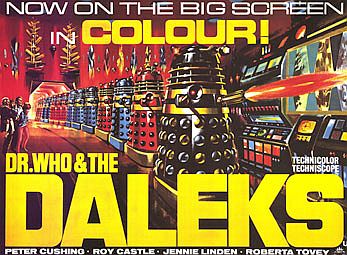
On the other hand, the classic movie posters look fab
The plots are stripped down versions of Dalek stories from the original series. This improves the pacing, but also makes the whole thing less engaging. Even the pleasure of seeing multi-coloured Daleks and the oddly painted Thals does not make up for intense boredom the movies produce.
As family-friendly action movies made in 60’s go, they aren’t that bad. But because it features Daleks and a TARDIS, we expect more. I can remember watching both these movies as a child, and being very disappointed. They are the Doctor Who equivalent of being promised chocolate and getting carob.3.
If I was producing a new Doctor Who movie today, I would give these movies some repeated viewings. Their greatest flaw is that they imitate the elements of the original series without any of the charm. Even though there is now a greater body of lore surrounding the show, the Peter Cushing movies should serve as an example as to why one should not re-invent the wheel when one is playing in someone else’s creative sand-pit.
1: Interesting studio, Amicus, often mistaken for Hammer Films as they also tended to make movies starring Christopher Lee and Peter Cushing. Dr Terror’s House of Horrors is one of theirs.
2: Roy Castle in the first one, Bernard Cribbins in the second. They play characters of course, but it really doesn’t matter, because both actors don’t have any real chance how talented they are. Both Cribbins and Castle are charming of course, which is why both went on to become much loved celebrities. (In the UK at least).
3: Carob looks like chocolate, and sort of tastes like chocolate if you don’t have taste buds. It used to be billed to concerned parents a healthy, vegetarian alternative to chocolate, but I suspect it was actually produced to instil into children a deep seated mistrust of vegetarians
Doctor Who, The Adventure Games
The BBC has always been keen to embrace new technology and media. If you grew up in the 80’s, you may remember BBC Microcomputers, TV shows like Micro Live and hi-tech schemes like the Domesday Project. These days, the British Broadcasting Corporation continues to experiment, and the fruits of this work include things such as iPlayer. One of their recent projects is to investigate the notion of video games as a way of telling stories. After all, Auntie Beeb produces some world class stories intended for TV and Radio, why not tell stories using mouse and keyboard?1
The latest result of these explorations are the Doctor Who: The Adventure Games, now in its second series. The games are first person puzzlers, you take the role of The Doctor and Companions (mostly Amy, though we also get to play Rory in the most recent series), and go on a limited adventure through time and space, fighting the usual sort of villains and saving the world in the process. Anyone who has internet access in the UK can download them for free, and they’re designed to run on most PC’s, the spec being rather minimal.
Quality varies depending on each individual chapter, and also on how much of a fan you are of the show. In each case, the actual graphics and interface can be best be described as average and adequate; these games are intended to be played by anyone , so don’t expect fantastic quality graphics or a radical departure from the usual conventions of games control; this can be a little frustrating at times but it does mean that if you’re rubbish at games you should be able to have a much fun as a seasoned First Person Shooter Champion.
The first series featured four stories. City of the Daleks was the first game they ever produced, and it really is there to make the geeks make happy little sounds; it begins in London, 1963, but oh no, the Daleks have invaded.1 . So is London the titular City of the Daleks? Well, not really, and that’s part of the fun. For a first try, it’s a pretty strong opener.

Voiced by the shows actors, the voice work clearly improves over time.
It’s followed up by Blood of the Cybermen, which is set on an Arctic base where things have gone horribly wrong. Combining classic Cybermen stories with the sort of frozen paranoia you get in classic sci-fi horror stories, and also has some of my favourite (yet cutest) Who monsters.
Game number three, TARDIS, is the weakest of the series, which is a real shame as it’s written by James Moran3, who’s a favourite of mine. It promises a chance to sneak around the famous spaceship and really fails to deliver, mosyly because it’s too short and too small. I suspect it’s a victim of time and budget rather than anything else.
The first series ends with Shadows of the Vashta Nerada, which features horrible shadow monsters and giant sharks. Again, it could be much better, and it’s a little maze-like in places. It’s still fun, though the first two games stand out much more than the last two.
The first series also featured a series of collectable items, little Easter-Eggs that told you either a little about real world history or a little about Doctor Who. They’ve sort of been replaced in the new series, and I have to admit I totally missed them first time, and the reason why made me laugh and groan in equal measure.
The second series has begun strongly with The Gunpowder Plot; again, it features the sort of thing that will make fans of both the classic and new series do a little dance, and the voice-acting has gotten much stronger. There also seems to be a interesting division of labour in this one; The Doctor does all the thinking, Amy does a lot of talking to people and Rory does a fair bit of heavy lifting, which is works quite nicely. It also seems much more keen to talk to you about history, and I did wonder if they had a copy of National Curriculum to hand whilst writing it.4
The series in general suffers from being simplistic and the ‘puzzle’ aspect of Doctor Who: The Adventure Games can be a little literal in places. It’s also a little buggy, but nothing that would hurt your enjoyment. As a video game aimed squarely at a family audience who happen to be fans, it works and I am looking forward to seeing more.
1: BBC projects you may have missed include Ghosts of Albion and the The Torchwood Alternate Reality Game.
2: 1963 is the year the show first aired. They do like to do stuff like this, and I think it’s great that this sort of care and attention is obvious in the work.
3: The rest of the games have been written by Phil Ford, who did a lot of work for that other Doctor Who spin off Sarah Jane Adventures.
4: Hooray for engaging kids in education. And adults, for that matter.
The Avengers, assembled once again
One of the fascinating things about Marvel Super Heroes is the way it constantly re-invents itself; for example, though the origin story of Spiderman has been told endlessly on the screen, stage and indeed in comic books, The House of Ideas1 likes to mix it up a lot, retelling the same ideas in different ways. In recent years, this has applied to Marvel’s foremost and best known superhero team, The Avengers2. Stories with teams in them are a bit of a bargain, you get to enjoy the adventures of multiple characters, rather than just the one, and if you’re promoting a brand3, it has the added advantage of exposing the audience to characters they may not have met yet.
The Avengers: Earth’s Mightiest Heroes is a recent cartoon TV series, that yet again re-invents the classic Marvel Super Hero team. We can see elements of previous versions within its structure; Iron Man resembles his recent movie incarnation more than ever (he even looks like Robert Downey Junior), Captain America’s origin resembles both the version seen in The Ultimates comic book and the recent movie. Each episode has been plugged together with a great deal of love and care for the mythology surrounding these heroes, and each one has been re-imagined in a way that’s fresh but also familiar.
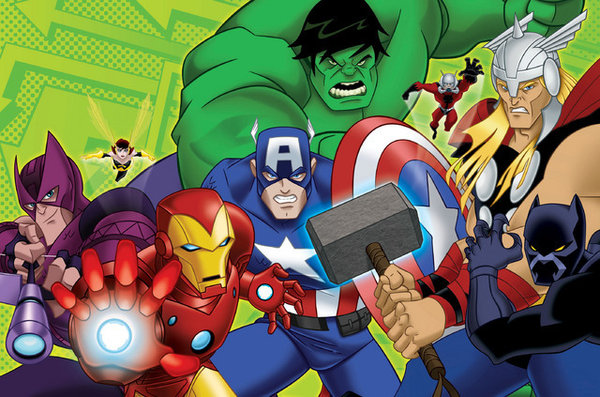
The main problem with the show is that, in parts, it’s a retelling too far. Every time Marvel redoes a story featuring the Avengers, it always starts the same way; the band gets formed in a way that generates a lot of tension and then they unwittingly face a conspiracy of mystically manipulated villains, almost falling apart in the process but ultimately becoming stronger because of it. If you’d never heard that story before, then I’m sure it would be fresh and exciting, but for me, I’ve already been there, many times.
Part of the reason for my fatigue is actually one of the strengths of the franchise, as this particular story is one of human frailty. It’s an examination of what happens when you thrust power and responsibility into the hands of flawed people.4. This is great, but I want to see the character development go beyond the first handful of stories. I want to see this aspect of the myth evolve in different media as well.
I want to see other, more obscure, stories about The Avengers retold in different ways; the comic books are filled with amazing weirdness and fantastic ideas. I want disassembled robots, the scattered souls of twins, world conquering androids and alien war zones; some of this is hinted at in The Avengers: Earth’s Mightiest Heroes but I’m greedy and impatient, and am never sure how long a show like this will run for before it gets cancelled.
I’m sure it’ll get a lot of attention in the run up to the forthcoming movie The Avengers, and if you’re in the mood for cartoon action, it’s worth a look.
1: Marvel Comics prides itself on the creativity, hence the self-styled ‘House of Idea’ sub-title. After all, you take away the amazing stories that Marvel has brought us over the years and you’d have nothing.
2: Not to be confused with the classic British TV series of the same name, which features super spies with vengeance in mind. That’s a wholly different kettle of fish, and I’ll talk about that some other day.
3: It isn’t soul-less to to think of superheroes as brands, provided you remember that the story should come first. This is storytelling as a business, and Marvel has proven time and again that thinking about the money makes a story no less valid. Disney bought Marvel for $4.24 billion. A business founded on comic books. Frankly, anyone who doubts the worth of storytelling through the comic medium is woefully misinformed.
4: The battle cry of The Avengers is ‘Avengers Assemble’. I often wonder if that’s because so many of the heroes are so interestingly broken.
 Ed Fortune