Archive
Worst Hugo Award Ceremony – Ever
If you were a British teenager back in the 1980s, there’s a fair chance that you’ll remember the 1989 Brit Awards. Presented by Mick Fleetwood and Sam Fox, it’s gone down in award ceremony history as how not to do the thing. Plagued by technical difficulties, presenters who had no empathy with the audience and a general lack of scripting and planning, I was pretty sure it was the worst awards presentation I’d ever see.

The 1989 Brit Awards are still painful to watch
All that changed when I made the mistake of tuning in to watch the 2020 Hugo Award ceremony, presented by George RR Martin. The Hugo Award ceremony is never the most slickly produced thing. And this year, the convention organisers 1 had to do the whole thing via the internet.
And just before we get into it: The speeches were amazing. The technical achievement was incredible. The team did very well on short notice (Worldcons take years to plan) and the things the winners said were important and deserving of respect. A super-cut, shorter version of the ceremony, can be found here:
You’ll note it’s shorter than the full ceremony. That’s because they cut out all the bits from Toastmaster, George RR Martin. The edited version is two hours shorter.
That’s right; the full ceremony was three and a half hours long. Two hours of this was George RR Martin reminiscing on his youth, whilst throwing shade at the new generation of Hugo Nominees and fans. Now had George been a gracious host, that might have been charming. But instead it was an old fan using his platform to lecture and bore his community, whilst disapproving of the community he claims to love.
For example, the award for new voices in sci-fi fandom got changed last year from being called ‘The John W Campbell Award’ to ‘The Astounding Award’. This is mostly because Jeanette Ng pointed out that John W Campbell was a “fucking fascist” and a racist, during her acceptance speech last year for that award.
As Ng acknowledged later; the fans have been trying to get the award changed for years, it’s just that Ng took a stand, risked her career and made the point at a critical time. It prompted the name change.
Martin used his platform to not only mock the way the award had been changed, but to repeatedly talk about Campbell, the noted fascist and racist. Martin would go on to mis-pronounce names (despite given clear guidance to the contrary.) It was a 210 minute dis-fest, punctuated by actually relevant members of the community popping on to accept their awards and say important things about the state of the world.
Worse, Martin changed the narrative of the ceremony. Most of the speeches mentioned the state of the world right now, which is correct for a science fiction awards ceremony. Winners talked about the harassment and bigotry they had to cope with from within the publishing world. They talked about the state of Hong Kong and Hungary. They made impassioned speeches that acknowledged the poor state of our planet right now. It was strong stuff. It was stuff that should be said.
And yet, here we are complaining about Martin and his attempt to sweep that all under the table and talk about himself.
This is not the first time George has been rude to those nominated for a Hugo Award. Back before the days of inside toilets and wifi, Martin invented a thing called the Loser’s Party; a silly name for the Hugo Awards Ceremony after-party. Over the years it’s become a bit of a legend, with talented types from the world of SciFi and Fantasy having fun. It’s become more than what it once was, much like the SciFi community itself.
Last year, at Dublin 2019– An Irish Worldcon, it was held at the spacious Guinness Storehouse. Martin later admitted that he had under-estimated the number of guests attending and it’s clear that certain cliques got in over others. You would assume that a Hugo Losers party would prioritise those nominated for a Hugo Award but didn’t win. Instead, the venue hit capacity and a number of the ‘losers’ couldn’t get in. They were left, outside in the rain. For hours. Waiting to get in to their own party
Just let that sink in; the Hugo Losers party didn’t prioritise the Hugo Losers on the guest list. Though of course George and friends did get in. That generated quite a bit of bad blood, as you can imagine.
The seemingly deliberate disrespect Martin gave to Hugo Nominees last night puts that incident in a fresh light: Martin does not care about the younger, more diverse people who now get nominated for a Hugo award. He can’t be bothered to get their names right and to him, the past is more important than the future. This is unsustainable for an organisation that is all about speculating on what tomorrow brings.
Worldcon and The Hugo Awards need to change. Future Worldcons will not only need to be accessible to those who can only access things online, or who choose not to attend a particular location, but it also needs to acknowledge that this is a world that no longer trusts its elders. Condescending and elite events like the ‘Loser’s Party’ need to go, replaced with something that respects the hard work of those involved with the awards.
The Brit Awards are a slick, well presented show these days. The Hugos need to learn this lesson – the conventions that host it need to spend the money, hire professional hosts and produce something worthy of those the world science fiction community wants to give its highest praise to. That means spending some actual money on the ceremony.
This should have been a celebration of New Zealand’s unique contribution to world of Science Fiction and Fantasy. This should have been a rallying call and an inspiration to the world. Instead it was an ageing white American millionaire rambling on endlessly about the last century, alienating his peers and throwing us back into the past.
Let’s do better in future.
1: Worldcons are volunteer ran. It’s not a monolithic organisation – those in charge change from convention to convention. It’s a feature, not a bug. It’s incredibly hard work and all of the volunteers and technical teams involved have done an amazing job under difficult circumstances.
Brave New Words Award 2020
Back in March, STARBURST Magazine announced it’s finalists for the Brave New Words Award. They are:
Evan Winter – Rage of Dragons (Orbit Books)
Max Gladstone and Amal El-Mohtar – This is How You Lose the Time War (Jo Fletcher Books)
Tyler Hayes – The Imaginary Corpse (Angry Robot)
Sady Doyle – Dead Blondes and Bad Mothers (MHP Books)
Nisi Shawl – New Suns: Original Speculative Fiction by People of Color (Rebellion)
Tamsyn Muir – Gideon the Ninth (Tor)

This year’s Brave New Words list is very exciting
In case you don’t know the award, it’s pretty simple. It’s an award for words that are Brave and New. It covers a lot of space, can go to editors, writers, bloggers and the like. It’s always exciting to managed.
I walked away from this year’s Starburst International Film Festival in March after vigorous chat with the team, which is the final bit of the of the shortlist process. We announced the finalists via the main website and in print. The plan was to then get the judges to judge the books, and announce the winner at Edge Lit. (We’d selected judges in January.)
Covid-19 had other ideas, and Edge Lit got cancelled. So we are taking our time with it all, and the results are likely to turn up an online convention in October/November 2020. Goodness knows how we are getting the award to people, that’s a job for a future Ed.
We are also planning to a new award, the Starburst Hero Award for Literary excellence. It does what it says on the tin, the designs are very exciting.
The panel of judges for the Brave New Words Award includes genre critics and media professionals. The panel includes Urban Fantasy author Russell Smith media expert Rebecca Derrick, book podcaster Jane Hanmer and book blogger Matt Cavanagh Finally, we welcome narrative expert Professor Esther MacCallum-Stewartto the team. They are excellent people and I’m looking forward to announcing who the winner is.
(Thanks to the magic of editing old blogs, you can find out who won here. )
Brave New Words Award 2019 / Edge Lit
Well that’s another Brave New Words Award done and dusted. The winner is Tasha Suri. The judges felt that her book, Empire of Sand, was just the sort of thing the award is far. It’s brave, it’s new and the words are absolutely lovely.
The award itself is on it’s way to Tasha. Expect to find the award’s journey appear on the Brave New Words Instagram sometime soon.
The actual statue is called ‘The Roboto’ and it modelled on the original Starburst Fantasy Award from the 70s. It’s the same model that get’s given away during the Starburst Film Festival, but with a slightly different base.
The judging process was fun. This time round we had more time go through the short list. Last year we had to work with a March deadline, as the award ceremony was a the Starburst International Film Festival. 2019’s award ceremony happened at Edge Lit in Derby, so we had ages to read all the books.
It was still an extremely tough list choice though. The final judging process was fun though. A long chat with lovely, intelligent well read people where we beat out what we liked about each work. As the chief judge I get to say ‘why’ a lot to the jurors, which was both fun and frustrating.
 The short list was: Aliya Whiteley – The Loosening Skin , Tasha Suri – Empire of Sand, Rachel Armstrong – Origamy, Claire North – 84K, Micah Yongo- Lost Gods and Tade Thompson – Rosewater.
Genre fans might notice that some of these nominations have appeared elsewhere in other award lists; The Brave’s mission statement tends to have some cross-over with The Clarke and The Kitschies after all. I think the nominations nail the very strong state of genre thus far, and the winner is totally spot on.
The final announcement happened at Edge Lit and was on just before the legendary raffle. Thanks massively to Del who came up with some genius slides and I think I wasn’t too boring. The audience seemed amused at my terrible puns, I think. I did leave the Roboto on the podium and had to rescue it just before the infamous drunken raffle occured and now it’s on it’s amazing voyage.
Starburst Editorial have given the okay to do this again next year, and Edge Lit is going to be a two-day affair next year. And yes, the podcast is coming back. It’s been a busy year.
Oh, and Edge Lit itself was awesome. I got to hang out with some of my favourite people, attend a couple of useful workshops and here some of the best writers in the industry talk about their work. Looking forward to next year.
On Starfury Speed and other stories
One of the things about spending a chunk of your life writing about other people’s fictional tales is you think a lot about how stories get put together. And if you’re me, you then get kind of annoyed when other people miss the point and try and pull a good tale apart for all the wrong reasons.
I love good criticism. A well written review is an art in itself. And I adore it when someone takes a great story and takes it apart skilfully. What I can’t stand is when a work gets taken apart because the critic decides that the story itself is wrong. For example, someone complaining that a vampire movie is bad because the vampires can walk in sunlight without exploding1, ignoring the fact that it’s a story and the storyteller can do whatever the hell they like with the tale.
The Starfury Speed trope is a modern example of favouring story over accuracy. It comes from the 90’s TV show Babylon 5. The show featured small fighter craft that happened to be very quick and agile2. Various parts of the story had the ships turning up in the nick of time, or just too late. So obviously fans corner the show’s creator JMS and ask “How fast do Starfuries travel? Or for that matter, any of the show’s many cool spaceships?”

How does it work? Unless the story is about the science, or that engineering is part of the creators message, then rule of cool applies. And Starfuries are really cool. (Image via TMC-Deluxe )
His reply? “At the speed of plot.” It’s a perfect answer from someone whose job it is to tell stories. Expanding on this though, it should be taken as read that if, say, the tabletop miniatures game states that the SA-32A Mitchell-Hyundyne Starfury travels at a certain speed, that doesn’t make it a rule that applies to all other media. It’s just a thing they’ve done to make the game work.
Looking for details that aren’t relevant to the story in order to criticise a story is not productive. If your argument that Superman is a bad movie because in the real world people don’t fly, you’ve missed an important step somewhere.
There are lots of examples available. My personal favourite comes from the UK LARP scene, were myself and friends happened to be playing Samurai Badger people in a fantasy setting. Various geeks wanted to impress upon us their knowledge of Feudal Japan by asking us stupid out of character questions and lecturing us at length about how ‘Samurai don’t work that way’. We had to patiently point out to people that we weren’t aware giant badger people existed in the real world.
All of this ties into another frustrating trope, called The Thermian Argument.3 You see, just because a thing works in a story, and you can justify it in the context of the story, doesn’t make you immune from real world criticism. Claiming its okay to overtly mock a whole section of real-world society because you’ve made up this thing that says it’s okay, doesn’t make it okay.
Good criticism is an art in its own right, and it’s healthy to bring stories into their real world context. It is not a contradiction to enjoy a story in its context and then pull it to bits when your pop it on the workbench that is a the real world, or even the context of another genre with different conventions. But deciding that one made-up thing is more valuable than another made up thing because they contradict each other misses the point of stories.
—————-
1: Vampiric allergy to sunlight of course, being something that’s toggled from story to story, and a clue that all vampire stories don’t share the same universe. You’d think this was obvious, but no.
2: The design was so simple that apparently NASA drew inspiration from it during their research into smaller space vehicles. I understand it was a ‘Why didn’t we think of that’ moment.
3: Coined by Folding Ideas here : https://www.youtube.com/watch?v=AxV8gAGmbtk. To be clear, The Thermian Argument is where you use a made up thing to defend yourself from criticism about problems wih the stories real world context. You justify something awful by saying ‘It makes sense in the story’.
Lies Sleeping – Ben Aaronovitch
If you are into both detective fiction and supernatural adventure stories, then we’d be surprised if you haven’t at least heard of the Peter Grant novels. The long running novel series has recently spawned its own comic book spin-offs, novellas and a TV show is still in development. Lies Sleeping is the seventh novel is the series proper, and we are happy to report that it’s still as fresh as ever.
Typically Peter Grant novels start with some sort of incident that can only be handled by Falcon; The Metropolitan Police’s own specialist supernatural crime division can handle. This time round though, we are pretty much dipped straight into the over-arching plot from the previous books. The mysterious Faceless Man, the villain from the last six books or so, is the focus of a major sting operation. This means changes for the team. It’s nice to see how things have developed.
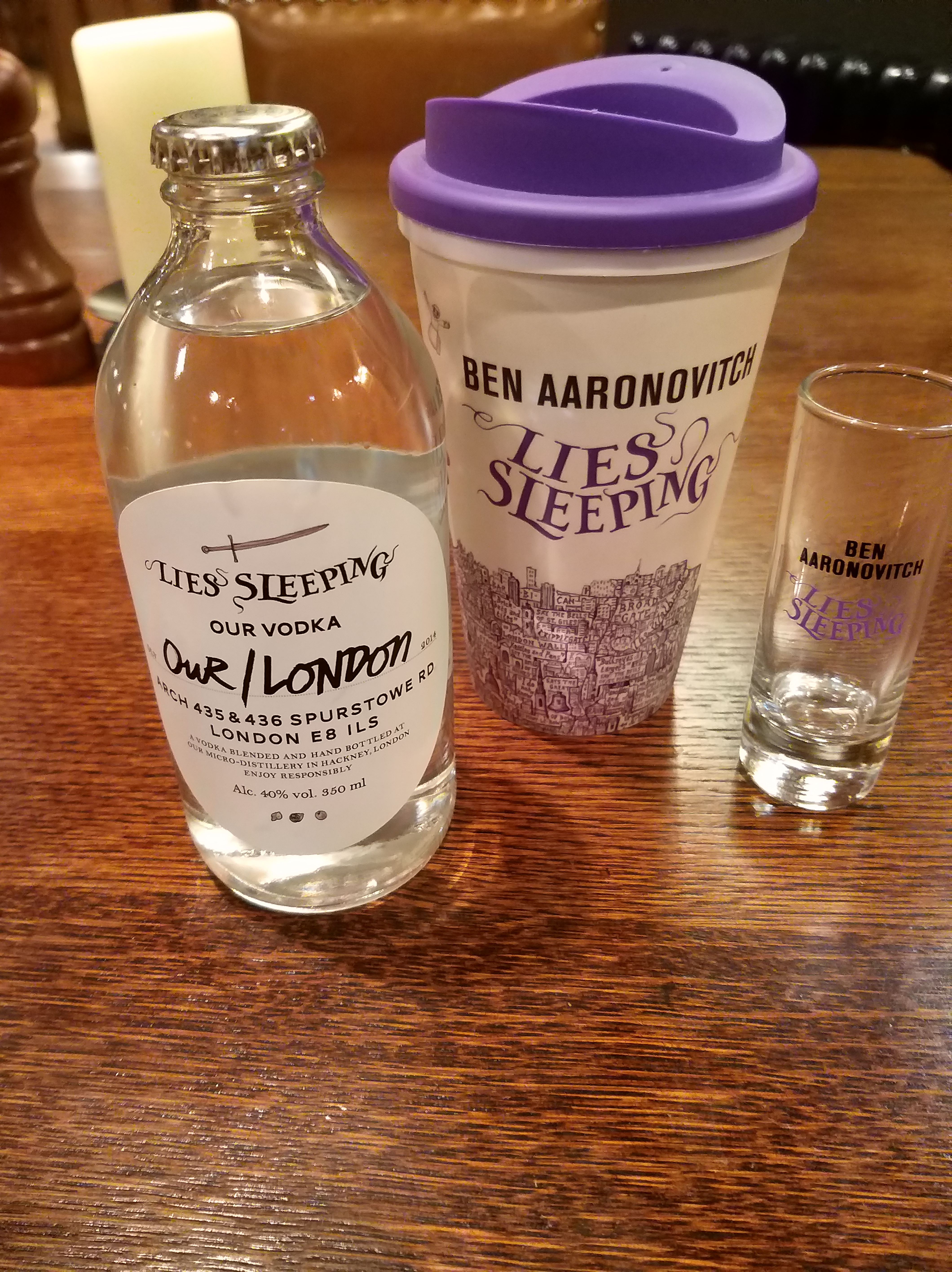
Merchandise.
In the first book of the series, Peter Grant was a humble Police Constable, still wet around the ears. By book seven he’s made it to Detective and regularly taking swims in rivers. His magical abilities are accomplished and reliable. His mentor, DCI Nightingale also feels much more powerful in both confidence and magical might. Even their cosy little base of operations, The Folly, has become a full-on operational centre, with everyday crime fighting professionals rubbing shoulders with the casual creepiness that lies in The Folly. This makes for solid development of the series; after all the characters must progress at some point and it’s been a joy so far to watch them strive through every little set-back.
Aaronovitch melds the magical and mundane extremely well. There’s a good mix of ‘London practicality’ and ‘unimaginable terror’ here; this isn’t a world where everyone can take the idea that magic is a real thing in their stride. Fear of the unknown keeps things in the margins, which provides a back-drop for the main characters struggles. Practical policing versus existential horror, to put in another way.
Lies Sleeping doesn’t try to catch up new readers, which is quite right. (Though if this sounds like your thing, do go and read Rivers of London first.). The plot dives straight into strands from the previous serious, tying up plot threads going all the way back to book one, whilst fraying new threads to keep the intrigue going. The pace is solid and steady, the action is as thrilling as ever and the whole thing ticks along like an old yet exciting friend. It would be unfair to call this more of the same, as the story delivers many answers. And at the same time, asks plenty of questions.
A must for fans of the series so far, and as always, we can’t wait to read the next one.
Speed Freeks
Very, very short review of this Games Workshop game would be: It’s everything GorkaMorka should have been, but wasn’t. And it’s as much fun as Gretchiniz promised to be, but wasn’t.
Of course, if you don’t know what either of those are, or what an Ork is, you’ll be a bit lost. Let me unpack it – an Ork is a sci-fi version of an Orc, the rampaging monsters from fantasy tropes. They’re gadget obssessed brutes who can’t spell. GorkaMorka and Gretchinz are both racing games (via Games Workshop), which combine dangerous and crude technological themes with rally style racing.
Warhammer 40,000’s Orks are perhaps one of the most fun things about the franchise. A perfect storm of parodies, not only of British 80’s subcultures but fantasy tropes, creating a brutish, sinister and ridiculous band of villains that you never the less root for. They tend to be at their most interesting when the story is about them. SpeedFreeks is Games Workshops latest box that’s just about the Orks. Namely, it’s a miniatures racing game about these horrible monsters trying to prove who’s the better driver whilst making horrendous amounts of noise.
The box comes with enough for two players. Six warbikes and two larger vehicles unique to the set. The warbikes are nothing special; Ork fans will have seen them before. The other two items are something else, however. The Kustom Boosta-Blasta is a nightmare beach buggy with massive wheels and a huge gun. The Shokkjump Dragsta is a race car from doom, imagine the sort of Formula One vehicle that the devil would invent. These two pieces are your main counters for the game and they fight each other. The models come unpainted, but the two mobs are in different colours (mustard yellow and bright red), for ease of distinction. You have to glue the models together yourself, and this will take most of us a couple of hours to do.
We also get some solid looking scenery which can be used in other games, and component quality is thick and solid.
Game play wise, it’s a cunning and brutal game. Stats are split into Kunnin’, Speedin’ and Shootin’, and you allocate dice appropriately. Movement is by template (or gubbinz as the game calls them) and the idea is that these vehicles don’t move in a straight line. Instead they skid, drift and spin across the board, mostly in a controlled fashion but not always.
This adds a push your luck element to the strategy, making the game a faster, chunkier and more satisfying vehicle combat game than X-Wing. What it lacks in depth it makes up for in explosions. The game comes with four reversible boards and yes, these can be used in games of Kill Team if you must. We have four scenarios, which all use the boards in a different way, including a Mad Max style chase mode that will have you repositioning the boards as you zoom across a desert landscape.
SpeedFreeks is a smoother, quicker game than we expected. As fans of the 90’s Ork racing game GorkaMorka, we were expecting something deeper and where pleasantly surprised. GorkaMorka was a gang war game with vehicle rules; SpeedFreeks is a racing game and not much else. That’s a good thing. A must have for Ork fans, and a welcome addition to anyone who likes racing board games.
Best iteration of this idea so far, a must for fans of Orks or Mad Max movies.
How To Invent Everything by Ryan North
Ryan North is as funny and he is smart, and he is very funny. Known for things such as Dinosaur Comics, Squirrel Girl and To Be or Not to Be, a book which turned the events of Macbeth into an adventure game. North’s signature style is funny yet informative, and with his latest How To Invent Everything, he completely outdoes all his previous work.
The premise of How To Invent Everything is that it’s a copy of survival guide for a stranded time travel. Allegedly discovered by North in the fossil record, it tells the reader that there is no way to repair a time machine. Instead, it advises the reader to rebuild civilisation from scratch, this time without making as many mistakes.
The first chapter is a description of both history and Earth’s place in the cosmos, cunningly disguised as a ‘how to work out where the time machine as dumped you’. Next we are onto the very basics; the fundamental technologies for civilisation turn out not to be fidget spinners and yodelling, but spoken and written language, scientific method, numbers that work and having some spare food. We then get into farming, mining, animal husbandry and so. All the good stuff.
Though disguised as a technical manual, this is anything but. It’s a fun history and explanation of humanity’s scientific achievements so far, with an added ‘how to’ on top. One of the recurring themes is exactly how long it took humans to come up with simple ideas such as wheelbarrows or keeping infants warm. They are fascinating (and carefully researched) facts here, all relating to human nature and their relationship with technology.
The conversational tone is charming, as well as the occasional gag about time-travel. (The fictional author in the book is angry at his boss at the time travel agency, for example.) It’s filled with lovely touches, such as all the historic quotes being from you, because you’ve gone back in time and nabbed those quotes. (They are also properly attributed, as is everything else)
Clever and well observed, it’s filled with everything you need to reboot civilisation. It includes substantial notes in the appendices and a general guide to useful animals and plants. This book is an almost essential primer on the story so far when it comes to science. We even go as far as basic computing, whilst also covering music, art and medicine. How To Invent Everything follows the Reithian principles of information, education, and entertainment, though it has the latter in spades.
I’ll be installing my copy in my personal time machine, of course. And getting copies for all my adventurous friends.
Escape The Dark Castle
For those who grew up in the 80’s, it’s odd to think of that decade of having its own distinctive style. The distinctive and simple style is immediately recognisable to many; not just the faded VHS and faux-neon look, but a simpler, scrappy style common amongst fringe magazines and books. Rapid fire adventure game Escape the Dark Castle taps into this retro vibe to create something that feels it could have been 1985’s hot new thing.
Escape the Dark Castle is elegant in its simplicity. You pick a character (A miller, a cook, a smith) etc. You’ve been imprisoned in the Dark Castle and you’re trying to escape. Each character has a bespoke dice and this reflects their strengths. The Smith does well in physical challenges so has lots of fist icons on their die. The Tailor isn’t that strong but is smarter and their die reflects this and so on.
Each round you draw a card called a ‘chapter’. You read out the encounter and roll dice to pass the test. Typically, this is a fight, but not always. You work together to defeat the encounter and move on, until you face ‘a boss monster’. Aesthetically, the whole thing looks great. A jet black box with a line art illustrations that look like they’ve come screaming out of some dark abyss of 1980’s style gothic fantasy. Big chunky dice. All the monsters are ghosts, demons, skeletons, proper old school nightmare fuel, the sort of thing aged moral guardians would make a fuss about. Cracking stuff. Quick to play as well, takes about 20 minutes.
It’s a fun team game with a solid narrative and a proper look and feel. It’s so retro I can imagine the Stranger Things kids playing it, but that just makes us love it even more. Like all good games of this sort, it generates fun stories amongst players. For example, when playtesting we ran into an encounter that lead to some particularly hilarious mental images where one of our heroes kept foul of traps. In-jokes where swiftly formed; it’s that sort of game.
This is a game that feels like it’s from the 80’s and is so good it’s survived the test of time. It’s a new game with an easy to pick up mechanic and feel that makes it feel like a classic. I understand the games producers have big plans for the future, so that’s exciting.
When Titans Attack
The Attack on Titan series proves the point that you can make even the most ridiculous idea and make it all dark and serious.1. I watched the first season ages ago, and enjoyed it for the high-tension nonsense that it was. I also got to interview Bryce Papenbrook, who does the English dub for the shows main character, Eren Yeager.
The interview is somewhere out there in the Starburst archives, but the thing that stuck in my mind is the Bryce was very proud of his ability to act and shout at the same time.
In case you’ve no idea what I’m on about, The Attack on Titan series is a pseudo flintlock fantasy world which takes place in a vaguely German like country. Mankind is under siege and lives in a massive walled city, with the upper classes living in the thickest wall in the center, with thinner walled bits of the city protecting the peasants.
The threat everyone is hiding from are giant man-baby monsters2 with grotesque heads that walk like toddlers and eat people whole. These are the titular ‘Titans’. It’s utterly daft and the animated TV show and accompanying comic books are hugely popular across the world, especially in their native Japan.
The main protagonist is a chap called Eren, who shouts a lot and hates Titans. He works with a team of scouts who swing around on gas powered grappling hooks smacking the monsters in their weak spots with huge swords.
The Roar Of Awakening is the third ‘movie’ instalment of the series. You may note that I’d only seen the first season at this point, though I’d read some of the manga (comic books) and felt up to speed. I was wrong. Between the blood, the shouting and the silly plot twists I had no idea what was going on.
‘Roar’ ramps up the conspiracy and paranoia, but it’s mostly lots of characters jabbering on at each other about nothing until another fight scene happens.
This is because Attack on Titan: The Roar of Awakening is a compressed and re-edited version of season two of the TV series. The editing makes for some interesting scenes; dramatic freeze frame with some dialogue over the top is used quite a bit in order to stitch the narrative into something vaguely understandable. The result is action scene after action scene, with lots of dramatic music, shouting, violence and the more shouting. The animation really shines at these points, with some great cinematic scenes of huge monsters punching normal sized people. Then eating them.
The problem is that if you didn’t know any about the series going in, well this is part three in an ongoing series; this is going to make no sense . It’s hard to really understand what this is for. Fans of Attack on Titan will want to five the full series a watch, rather than this butchered shorthand. At two-hours, it’s a heck of a long recap.
Though I get why these things exist, I really wish they didn’t. Honestly, if you’re going to watch this weird and macabre thing, you need to invest the time into it.
1: Genuinely not a good thing. Not everything has to be dark and edgy, after all.
2: Yes you read that right.
BANANAMAN – The Musical
I first heard of an adaptation of Bananaman in the works a couple of years ago. Originally intended as a movie, they aimed much lower as it developed and turned it into a musical.
We are currently living in a world where comic-books are king. However, notably, missing from the huge roster of comic book reboots are characters from The Beano.1 This national treasure has never taken itself seriously and is packed with very silly fun. Enter Bananaman The Musical, an attempt to add this unique voice in the world of comics to growing chorus of superhero stories. The result is highly pleasing; A hilarious musical for Generation X and their kids.
For those who weren’t lucky enough to be young in 80’s Britain, Bananaman is a deeply silly take on boyish power fantasy comics such as Bill Parker’s Shazam, Siegel & Shuster’s Superman or Mick Anglo’s Marvelman. Eric Wimp is a schoolboy who, when he eats a banana, turns into a yellow and blue musclebound idiot who can bend steel and fly. Many of us will remember the 1983 cartoon, featuring the vocal talents of the Goodies. Sightline Entertainment, the producers of this show certainly did. As we entered the Southwark Playhouse’s main stage, the interlude music was a collection of 80’s kids TV show theme tunes.
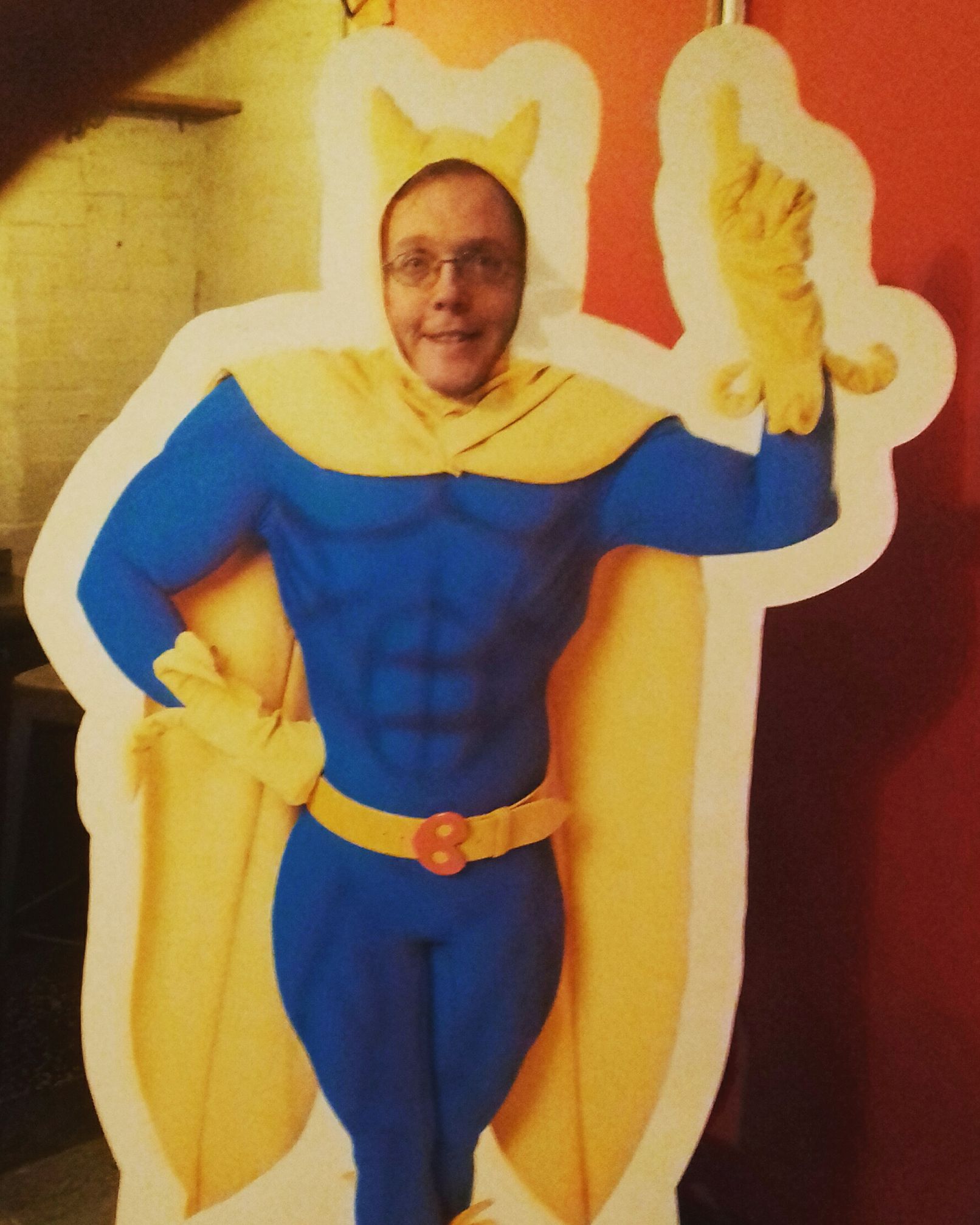
The show opens with an explanation of how boring Eric Wimp’s life is, how dull Acacia Road and introduces the characters. Notably, Fiona the Newsreporter is re-imagined as a schoolgirl reporter with own YouTube channel, and is an actual character rather than a prop. In proper Beano style the girls are just as awesome as the guys, thank you very much.
Jodie Jacobs tackles the difficult task of Crow exceptionally well. This is a crow that flaps around and sings, and the puppet is very charming, very witty and carries much of the narrative on its slender feathered shoulders. Mark Newnham sells the earnest rubbishness of Eric Wimp perfectly, and Matthew McKenna is clearly having the time of his life as Bananaman. His comic timing his perfect.2
The show is stolen, in part, by the villains. Which is exactly what you want. Marc Pickering is Doctor Gloom, and chews the scenery as the smartest buffoon in the room and has all the best songs. Carl Mullaney’s General Blight tempers Pickering’s performance with an absurd sense of manic outrage and the two bounce off each of as cackling baddies throughout.
The songs are fun, cracking and catchy. They tell the story but are the sort of songs you’d listen to again and again. They mock the recent seriousness of the superhero genre with a playful sense of fun and are quite memorable.
They are some flaws with the storytelling; Eric’s intelligence is established early on, in fact his nerd and geek credentials have their own song. When Eric turns into Bananaman, fans know that the hero has the muscles of twenty men and brains of twenty mussels, but this isn’t established until much later. It’s a minor detail, but one that could be easily fixed. The scenes at the end rush slightly too quickly, but that’s fine. By now you’ve climbed aboard the Banana boat of fun and are laughing so hard it’s tricky to keep up with the gags.
The venue also delivered a few sound issues early on, but these where swiftly resolved. That said, this isn’t a super-slick production and nor should it be. The source material is chaotic and silly and that’s part of the appeal. A highly professional production throughout though one with a deliberately anarchic vibe.
I particularly loved the way some of the ensemble cast where dressed as ‘brown-coat and flat cap’ janitors when moving bits of the set around, and that they were actual character.
A splendid fourth-wall shout out that was instantly recognisable to the target audience. Costume Supervisors Nia Evans and Daisy Woodroffe have done an amazing job getting the look the characters spot on, right down to the socks and the titular hero looks as silly as he does wonderful. They are some lovely Easter Eggs in the show’s design, from the mortar-board hat on the teachers to a sign pointing to Bash Street. Director Mark Perry has nailed it; this is The Beano come to life.
Bananaman The Musical is a lovely ripe banana, dipped in nostalgia and fun, served with glee and manic silliness. Sadly it looks like it won’t tour. The press junket we attended seemed focused mostly on the London theatre scene, and this is definetly a show aimed more firmly at what marketing types call ‘Facebook Families’3.
This sort of thing is exactly what British Theatre needs – fun, friendly and commercial. It’s a huge shame that not even the soundtrack is available anymore. Hopefully someone will bring it back to life.
1: A fine and fun kids comic from DC Thompson, and an amazing example of British humour.
2: I confess that the first quick-change caught me unawares and I was utterly impressed. Then I realised that Wimp and Bannanman are played by different people. I am a muppet.
3: Middle Class families looking for something for the kids that won’t bore the adults. But cost is king. We all know a Facebook Family, they’re the ones with their little ‘uns in the profile.
 Ed Fortune