The Voice
I usually don’t get on well with reality TV. Typically because the only real thing about them is that they feature someone in a position of authority bullying some sort of supplicant, be they a jungle dwelling media-idiot, a fat person trying to lose weight or some sort of awful parody of a businessman. I especially dislike X-Factor style shows. Not only does it reinforce the myth that everyone in arts wants to be a superstar1, it’s actively cruel, and is mostly an exercise in cramming square pegs into round holes.
So it was with some reluctance that I turned on BBC’s The Voice, expecting it to be yet another bit of awful exploitation of people’s hopes and dreams. Still, I thought, it’s got Tom Jones in it. He tends to be a sane voice when it comes to talking about music, and entertaining in general. Maybe it’ll be okay. I was wrong, of course. It’s not just okay, it’s remarkable.
The format, for those who’ve not seen it, begins with blind auditions of those who want to boost their career as singers. They are four judges, two of whom you’ve heard of, one of whom you’ll recognise when you check out his profile out and go “oh, the Black Eyed Peas” and Danny O’Donoghue.3. They listen to the artist, and only turn round if they’re willing to put them on their team.

The show’s logo, however, is less than good. It’s like all the pop-stars formed a red army or something.
Once the four judges have assembled a team of artists, they then put those artists in a boxing ring, where they sing at each other, in a surreal (yet entertaining) version of a gladiatorial match. Finally, after all that, the artists are thrown to the wolves. By which I mean a public vote. Because it’s a reality TV show and they have to make money from it somehow.
The novelty, however, is not the format. (Which comes from the Netherlands). It’s the fact that the show does not pretend that most of these artists have been pulled off the streets and thrust into stardom. Instead, almost all of the contestants have had some level of experience trying to become singers; these are people at the start of their careers, who are getting a massive boost by appearing on national television.
The show isn’t about selling you a dream of having superstardom thrust upon you, rather it’s about talent and hard work, as well as public participation. Whereas similar shows claim to be about training the next generation of artists (but are actually about letting the public throw peanuts at aspiring artists), The Voice is about the music, rather than the fame, and not only raises the bar for reality TV shows, it actually raises the bar for being a person, if only by a little bit. Let’s hope it stays this positive in future series.
1: If you sing, write or dance for just the money, it’s highly likely that you’ve chosen poorly. None of these things are easy, though of course, the professionals make it all look effortless. To encourage someone to get into the arts in order to be a superstar is the wrong approach entirely.
2: Seems to me that the general public has finally noticed that Simon Cowell really doesn’t know what he’s talking about. Possibly this is that he’s very good a playing the role of someone who can talent spot, even though the results of his talent spotting where incredibly pedestrian. The current gossip about the man is all sex scandal, which tends to be death rattle of the talentless.
3: Honestly, who? I mean he seems nice and his heart appears to be in the right place (by which I mean I don’t think he’s a Timelord), but seriously, who is he?
Star Wars Clone Wars (2003)
I am a great lover of puns, so naturally, I have no problem with people using today’s date, May The Fourth, as an excuse to make sneaky little Star Wars references to each other. It’s also pretty fun that others wave their geek flag around by throwing in other sci-fi references , random quotes and the like1. So really, I should talk about Star Wars again.
As I’ve stated before, I don’t think the movies are anything terribly special. To me, it’s the shared universe and the fact that it’s given various arty types an excuse to produce epic, space fantasy style tales that matter. One fantastic example is Genndy Tartakovsky’s Star Wars: Clone Wars2. Set between Attack of The Clones and Revenge of The Sith, this is short cartoon series produced by the same guy who brought us Dexter’s Laboratory, The PowerPuff Girls and of course Samurai Jack.

Jedi versus Sith; Six movies worth of conflict summed up in one frame.
Of these, the Star Wars cartoon most resembles Samurai Jack; itself a series about a swordsman fighting futuristic creatures. In Star Wars: Clone Wars, we get a series of short stories, each one a snap-shot of an epic inter-galactic war. The focus of many of these tales are the Jedi. The animation resembles Tartakovsky’s previous work, whilst maintaining the iconic Star Wars look. So for example, Padmé Amidala looks both cute and exotic, whilst also cool and deadly. Emotion is conveyed in a very simple, easy to comprehend style, and because it looks so simple, we accept it, move on and thus allow the story to draw us in deeper. (It would be unkind to point out that the cartoon version of Anakin Skywalker is more expressive than the live action version. It’s also true, sadly.) It’s also filled with visual reference to previous Star Wars cartoons, and lovingly crafted cues and homages to the broader franchise.
As Star Wars is so ingrained into the culture I’m a part of, I have no idea if it works out of context. I think it would; warriors doing cool things are a pretty easy idea to get a handle on and enjoy, after all. Star Wars: Clone Wars, really is the best thing to come out of the prequels, and is the closest thing to the promise of a War in the Stars that the Lucas franchise has come up with thus far.
1: It’s also a little dull, which is a sad and inevitable consequence of something becoming part of the background culture. For some, there’s a fine line between liking something because it’s fun, and liking something because everyone else does. Once the line is crossed, there’s a chance people will simply repeat the same lines and make the same noises simply to have something to say, rather than out of a sense of joy. Inevitably, the thing becomes mundane.
2: Not to be confused with the CGI series of a similar name, which came later.
The Avengers – movie phenomena of the year
Apparently, if I hadn’t gone to see the The Avengers 1 this weekend, the geek police would have turned up at my door and taken away my geek card and nerd privileges. Or something. It’s mostly pointless to pretend to review what is rapidly turning out to not only the box office smash of the year, but the younger generations equivalent of Star Wars. 2
Go see it, if not to prevent people from endlessly telling you to go and see it. If you’re a comic-book fan you’ll emit little squeals of nerdy delight, if you like big budget hero movies, you’ll love it. The rest of you will find the performances engaging, the wit sharp, the heroes pretty and the plot doing its best to not get in the way of the fun.
More interestingly, the The Avengers shows that the super-hero movie has finally reached the point where it can not only emulate the more intricate elements of the comic book format, it can excel it. Namely, the idea that you can set multiple stories in the same place. This isn’t particularly news, recurring characters have been a feature of films in the past, but this is the first time that the concept of a shared world, spread across multiple movies, has taken centre stage.
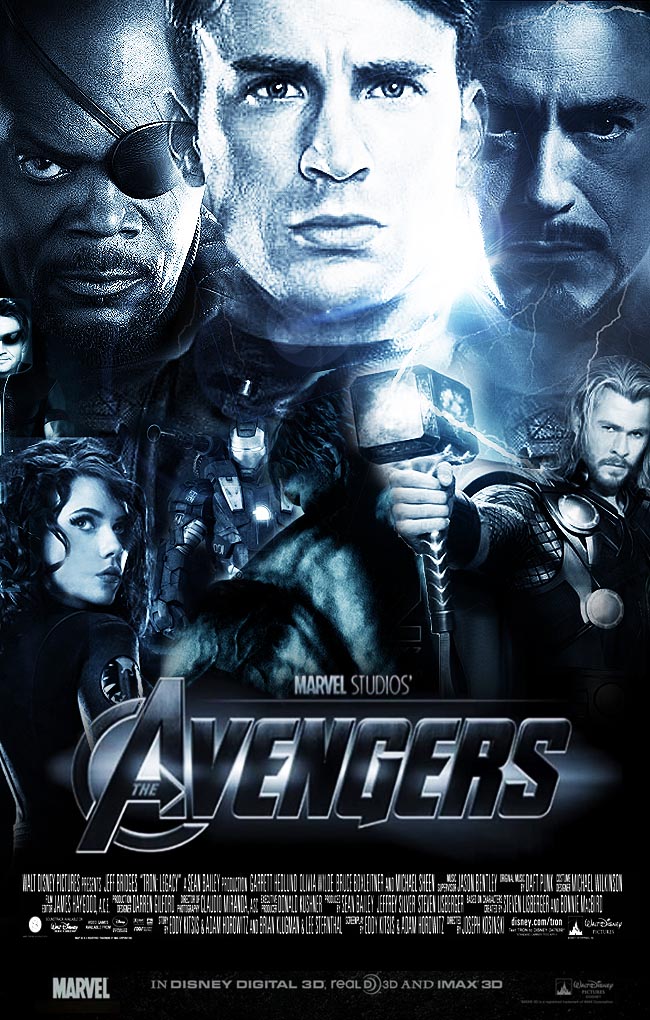
Avengers. Assembling. Never seen in Ikea.
Audiences have proven that they can ‘buy into’ a coherent world and setting, in this case the Marvel Universe. Remember, The Avengers is not just set in the same world that the Thor, Captain America and Iron Man movies were set in, it also (technically), exists in the same place that Ghost Rider and Blade exist. In theory, any of these characters could turn up in a movie with each other, and though it’s unlikely that Marvel will produce a romantic comedy featuring Spider Man’s Flash Thompson and Patty ‘Hellcat’ Walker3, it’s more possible than it was last year. Moreover, other franchises will now try the same trick. I expect to see Batman taking on Superman sometime soon. 4
The other thing it means is that comic-book geeks are now mainstream. But then they always were; The Avengers (and their corporate rivals, The Justice League) are modern versions of god-like pantheons, a repetition of the stories of heroism that we’ve been telling in different ways since we could tell stories. It’s just this time, when we tell, they are explosions.
1: Apparently it’s actually “Marvel’s Avengers Assemble”, presumably to distance it from the 1998 movie “The Avengers” that completely misunderstood the classic TV series of the same name. Personally, I’ve always found comparing the British Avengers (a super-spy TV show with incredibly weird moments) with the American Avengers (a super-hero comic book with incredibly weird moments) a nice study in the differences of cultures. Also, the British Avengers actually have stuff they want to avenge, but that’s a different rant.
2: My generation’s Star Wars was Empire Strikes Back. Pity today’s adolescents, their big Hollywood movie was The Phantom Menace.
3: Patsy Walker is an interesting example of the weird adaptability of the Marvel Universe. She began life as a character in ‘teen romance’ comics, and was eventually re-imagined as Hellcat, a kick ass crime-fighter in tight spandex. Imagine if you will, a version of Sleepless in Seattle where Meg Ryan suddenly becomes a deadly assassin, beats up Tom Hanks and then goes on to save the world from shape shifting alien monsters. I’d watch that movie.
4: Of course, a lot of TV is connected to other TV. At least according to the Tommy Westphall Hypothesis, which isn’t the name of a rock band, it’s an odd little idea that much of American TV is a child’s dream.
Rockets, Rayguns and Really Nice Tea
As you may have gathered, I ran a larp event sometime ago. It went well, apparently.
Rather than try and explain it, we’ve thrown together a video that combines photos of the event alongside one of the games easter eggs; an audio tape detailing a disastrous mission to mars. Enjoy.
House
A small amount of fuss has been generated recently by the announcement of Elementary, an unauthorised American remake of the BBC show Sherlock. This confused me greatly, as there’s already been an extremely successful version of the Arthur Conan Doyle’s hero, updated for a modern audience. It’s called House.
Powered mostly through the performance of Hugh Laurie1, House follows the exploits of a damaged yet brilliant doctor, whose genius sets him apart from the common man. His ego and arrogance is such that he must constantly seek challenges and solve medical cases, as to avoid doing so means that he would go quite insane and be driven to self-destruction. He is aided in this by an equally brilliant, but empathic companion, a Doctor Wilson. House and Wilson team up every episode to fight obscure illness and disease.
Well, that was the idea, anyway, and in earlier seasons, that’s what we got; the adventures of a damaged, cruel yet brilliant soul, an engaging and interesting puzzle to solve (though rather than a complex crime, it being a medical show, it was a complex illness) and a supporting cast designed to generate conflict, high-light the ethical side of medicine and generally allow us to enjoy Laurie’s full tilt performance of a dangerous yet brilliant lunatic.

Grumpy Doctor Adventures
House began brilliantly, but whereas British shows have a habit of finishing when the creative team have ran out of things to say, American shows are more likely to keep running until public interest wanes and the money runs out2. This is a problem, as they are only so many interesting medical stories that you can make fit into a crime-style story. At its heart, House is a detective story with a biological twist; the criminal may have always been some obscure illness3, but the crime was always interesting.
As the series progressed, however, it became formulaic; it was no longer about the good detective fighting the human condition, but instead, the broken curmudgeon fighting the world. This worked for a while, pretty much on the weight of Laurie’s acting, but what we have now is a better than average medical drama, rather than a brilliant detective show in a white coat.
House is reportedly in it’s last season, and I am personally hoping that the show ends with the grumpy git fighting the elemental force of cancer in a sword duel over a waterfall. I suspect I’ll be disappointed.
1: The talented one from eighties gag-show, Fry and Laurie.
2: That the BBC can do short-run, brilliant shows is one of the many reasons that you shouldn’t whine too much about your license fee. That and the fact that it irks Rupert Murdoch.
3: But never Lupus, which is a devastating illness and alas, is nothing to do with werewolves.
John Carter
Edgar Rice Burrough’s Barsoom series were, for me, part of growing up. A bunch of weirdly fantastic, metaphysically strange adventure stories where a relatively two-dimensional1 dude is thrust into a world of princesses, monsters, mystics and double dealing. And all of this takes place on Mars.
So, being the sort of chap that I am, I was pretty excited by Disney’s John Carter2, and having come in with low expectations3, enjoyed it immensely. It’s pretty flawed; a lot of the charm from the original novels has gone in order to update it to modern tastes, but at its heart, the feature stays with the essence of original books; Mars is huge, strange and filled with the profoundly weird and exotic.

Brought to you by the man who invented Tarzan.
The four-armed, green skinned Tharks, on which much of the original story revolves, are interesting and likeable. The martian princess4, who is essentially the central character, is interesting and engaging. Sadly, the actress cast for the role is pretty rather than strange-looking, but the performance is powerful and the character is strong and independent, as it should be.
As for John Carter himself? Meh. He’s eye candy and carries the story forward the way he’s supposed to, by being a proxy for the viewer. This is a true fantasy movie, and the books that inspired it have been huge influence on more familar films; elements of the Barsoom books can be found in big chunks of American Fantasy and Sci-Fi stories from Superman to Flash Gordon, from Star Trek to Star Wars.
Does John Carter does its legacy justice? Yes, just about. The sad fact is that by making a movie that would appeal to a larger market, they’ve cut away the true strangeness of the original work (which is just under a 100-years old), and we are left with a movie that fails to excite the average non-geek and merely teases the truly nerdy amongst it with a vision of what was almost great.
Also, the White Apes looked brilliant.
1: Lot’s of pulp-action heroes are relatively simply drawn. Critics pan the Twilight novels for a rather flat female lead whilst conveniently forgetting the vast army of near-perfect male heroes in all sorts of fiction aimed for boys. Flat can be fun, if the rest of the world is vivid and interesting.
2: Much has been made of the fact that the movie is not called John Carter of Mars. Thing is, that would also be misleading, as the movie is broadly based on the first Barsoom book, Princess of Mars.
3: It’s worth pointing out that this isn’t the first time the book has been adapted. Asylum got there first.
4: Hey, this is a Disney movie? With a princess? I demand that Dejah Thoris be added to the list of Disney Princesses. With any luck, she’ll team up with Mulan and kick the arses of the rest of them, drilling some self-reliance, confidence and self respect into Ariel, Belle and the rest.
Runaways
Marvel Comics has never been afraid to look for new ways to sell its tales of super powered hi-jinks, and quite often, these experiments yield interesting and enduring results.1 One rather nice example is Brian K Vaughan’s Runaways.
Original pitched at manga reading teenagers, the book found popularity amongst comic book fans of all ages; after all, a light sprinkling of teen angst can go a long way, especially if you add super powers.
The premise of Runaways is quite fun; a band of teenagers who have known each other through childhood stumble across their parents performing some sort of sinister and evil ritual. This being the Marvel Universe, the kids jump to the conclusion that their folks have to be some sort of super villain team. Convinced that their own lives are in mortal peril, they make a break for it and go on the run, uncovering amazing revelations about themselves and their families on the way.

Original, fun and refreshing, but still very Marvel.
Runaways is a rites-of-passage tale with a heavy focus on emotional journeys and personal revelation. The kids argue, make-up and inevitably bond, becoming not simply a team of heroes but a family2 . The Marvel Universe stands out when everyday problems (such as teenage homelessness) run smack-bang into impossible things (such as The Incredible Hulk).
The other nifty thing about Runaways is that all the super-powered elements are really, really cool. From intelligent uses of over-used super powers to novel gadgets and resources (including frog-shaped vehicles and pet dinosaurs), the book takes familiar comic book tropes and makes them young again.
The original series of Runaways is well worth your time, as is the Joss Whedon run, especially if you like a little soap-opera in your comic books.
1: Case it point, the Ultimate series of books began life as a way to explore old stories in new ways, with an eye to perhaps making Marvel Movies. So much so in fact, that the reimagined comic book version of Nick Fury looked like Samuel Jackson in the hope that they could convince him to play that character in the movies. (It worked.)
2: Family is a major theme of the Marvel Universe, from the Fantastic Four onwards.
Flash Gordon
Thanks to the convenience of home cinema, these days we all tend to have movies that we can watch again and again. They are a non-fattening sort of comfort food, and tend to be as wide and as diverse as people are. The feature that happens to be my cinematic bowl of chocolate ice-cream is 1981 sci-fi flick Flash Gordon.
In case you’ve missed it, the plot is as simple as it is fun; Football1 player Flash Gordon stumbles upon an alien assault on the planet Earth. With the assistance of a crazy genius and a sassy New York City girl, Flash embarks on a quest to save the Earth, picking up a menagerie of strange and exotic allies along the way.
With lavish sets and frankly ridiculous costumes, the world of Flash Gordon is one of pulp adventure and comic book weirdness, and it’s the real star of the movie. Sam Jones, who plays Flash, suffers from a lack of acting skill. Luckily, everybody else in the feature overacts in order to make up for it. The glorious scenery is chewed into tiny bits, and the result is wonderfully over-the-top.

Instantly quotable, utterly unforgettable. Also features rocketships.
Max Von Sydow is glorious as the Emperor Ming, a combination of high-camp villain and fatherly monster. This is the movie that gave Brian Blessed some of his best known catch-phrases 2 and allows to see a well-loved children’s TV presenter die a slow and lingering death. It also features Italian national treasure Ornella Muti3 as the Emperor’s Daughter. Thanks to a series of skimpy, body hugging outfits, Flash Gordon is responsible for the stirrings of all sorts of feelings in many a teenage boy.
This is a movie without subtlety or subtext, with a tiny hint of dark humour for taste. It’s filled with beautiful people being energetic and exciting, often in various states of undress. The plot is as complicated enough as it needs to be, the twists and turns are there simply to keep you on your toes and the characters are just deep enough for you to forget how shallow they are. It also features a sound-track by the rock band Queen, artists who, in their time, were famed for being every bit as ridiculous and camp as Flash Gordon .
1: Well, American Football, a game in which there is not much kicking and the ball isn’t round. Though I suppose ‘Hand Egg’ is a silly name for a sport.
2: Say it with me “Dive my Hawkmen” or failing that, “Gordon’s Alive”.
3: Wikipedia tells me her breasts are insured for $350,000. I have no idea who handles things like this. Go Compare, maybe?
Eternal Law
If you were very lucky, you will have missed ITV’s recent attempt at genre drama; supernatural stinker Eternal Law1. The idea is quite a nice one; angels in the form of man take the guise of barristers to defend the innocent, typically fending off similarly disguised demons as they do so. Potentially, this could have been a great mix of court-room drama and supernatural adventure.
What we got was a poorly acted, badly thought out melodrama. It’s almost as if the producers thought that the idea (which though nice, isn’t terribly original) would be strong enough to carry the whole show by itself. The problem wasn’t just one element; this was a potentially brilliant, genre defining TV show let down by a lack of decent stories. Plenty of good ideas and yet not a single one of them was handled well.
The main characters had a lot of potential; the naive and child-like Tom, the bitter yet savvy Zak and the mysterious and capable Mrs Sherringham may have been a bit cliché, but they were strong enough to carry the story. Sadly, instead of letting the viewers getting to know the heroes, we instead got a lot quick fixes and most of the problems in the plot seemed to be resolved either by having the heroes shout at someone, or another character having an inexplicable change of heart.
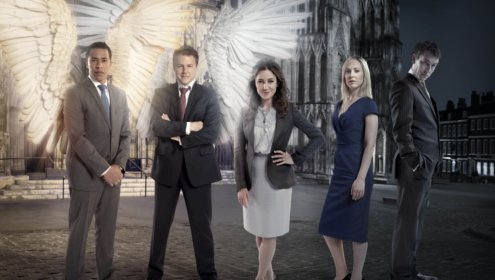
Great idea, pity about the execution
Eternal Law was filled with some great moments; two angels sitting on top of York Minster having a swift drink talking about saving the world through better legal-aid sold the show to me initially, as did the various one-liners. After all, few shows ever get to have someone say “Hosanna singing ponce”. But nice set scenes do not a story make, and it’s main problem was that it couldn’t decide if it was a low-budget courtroom drama show or a low-budget supernatural thriller. By trying to be too many things, it ended up being nothing.
The real shame here is that not only has the show been cancelled, every botched job like this makes it harder for similar ideas to take their place. Eternal Law wasn’t a bad idea, it was just badly made. It’s tempting to poke fun at the show, but its so poorly put together that I suspect strong language may somehow make it fall apart. I haven’t the heart to be mean, because it’s so naff that I feel sorry for it.
If you want an interesting take on the divine and infernal interfering with the affairs of man, I recommend you check out Chris F Holm’s latest book Dead Harvest instead. Not only is it a better idea, it’d make a cracking bit of telly.
1: Previous efforts to make interesting genre shows have included Primeval and Demons. Whereas the former probably deserves its own post, the latter was the forgotten offspring of Buffy The Vampire Slayer and Coronation Street without any of the charm that might imply. Best let sleeping Demons lie.
District 9
Human beings like making up rules for things, and quite often this a good thing. Driving a car is much safer if everyone sticks to the agreed upon rules, and games like chess are pretty rubbish without any sort of system1. But sometimes we make stupid, arbitrary rules that make no sense, such as “You can’t have an intelligent sci-fi movie that is also action filled and fun”. Typically, this is an excuse to justify some rubbish blockbuster, but it is complete nonsense and I can prove it. Take, for example, District 9.2
District 9 is one of those sci-fi movies that uses fantastic elements to comment on real world issues. An alien spaceship becomes stranded on Earth, specifically Johannesburg in South Africa. The aliens are taken off the ship, and put into slums and ghettoes. The responsibility is palmed off to a third-party, corporate interest and mankind does its best to exploit the wealth of technology that has landed on their doorstep whilst trying to ignore the now stranded aliens, pretty much leaving them to rot.

The look and feel of the movie evokes a believable, news report style feel to it all
Sounds preachy? It’s not. It’s a rip-roaring sci-fi action movie, which uses documentary-footage as interesting framework. The story is told from multiple perspectives, and over time makes us understand actions of everyone involved, even those we aren’t going to particularly like.3
Comparisons to 1988 movie Alien Nation, which begins with a similar sort of set-up, may seem a bit inevitable, but the two movies couldn’t be any more different. Alien Nation is a buddy/cop movie that owes more to the likes of 48 hours and Red Heat than it does to any sort of serious look at race relations; it’s ultimate message is an optimistic and happy one from the start, whereas District 9 is a much darker, more gritty view of the world. It assumes that mankind is venal, selfish, lazy and easily repulsed by things it doesn’t understand, though also capable of being something much better. This isn’t a feel good movie, but it is honest, and by being blunt, becomes more real than any slow moving, lecture driven, overly-worthy sci-fi drama ever could be.
District 9 is smart sci-fi in which big things go boom and weird stuff happens. It’s also thought provoking, clever and brilliantly executed, and well worth your time.
1: I mean after you balanced the King on your head and stuck a pawn up your nose. After you’ve done that, the entertainment value has pretty much gone.
2: Apparently, this project came about because a feature based on the video game Halo fell through. Now, that could have simply been another silly blockbuster, but we could have had something that changed the rules on franchise movies. Ah well.
3: It’s easy to make us care about the lead character and the various aliens in the story. But there’s even a point where we feel a pang of sympathy for the villains of the piece. Like many stories about the alien on the doorstep, District 9 is a tale about being human.
 Ed Fortune