Elementary Mistakes
A little while ago, Sue Vertue1 expressed her displeasure over CBS’s announcement that they were going to produce a show similar to the BBC’s excellent Sherlock. She need not have worried, the American take on a thoroughly British idea, called Elementary2 does not come within a country mile of Sherlock, especially in terms of quality, plot and originality.
The problem is that it’s more beholden to the rules of American TV than it is to the source material. 3 So rather than a brilliant yet austere man who, by modern standards, may well be considered a danger to society, we get an edgy and cool adolescent who has kinky sex, goes to addiction counselling and admits that he could be wrong. It makes for a great detective show, but doesn’t live up to the promise of Sherlock Holmes.

Less the Great Detective, more the great big man child.
It is a huge shame; the roles are superbly performed. Johnny Lee Miller is an excellent Holmes, and injects manic intelligence and dispassion into the role. Lucy Liu4 is a superb Doctor Watson, being sharp and hard enough to be the great detective’s companion. However, this is a dynamic familiar to many a crime drama, and it doesn’t evoke the classic work. Given that it’s meant to be a direct re-imagining, it seems a bit of a waste.
What I wanted was a Holmes style version of Person of Interest (which is also produced by CBS) and what we got was something more akin to House than Sherlock; it’s a clever remix of old ideas, and though this makes for a good show, it doesn’t make for a remarkable show. TV is moving on from the tired old formulas of crime drama, and it’s sad to see such talent go to waste on something that could have been much, much more.
1: Her productions credits include Mr. Bean, The Vicar of Dibley, Coupling and two small boys with her husband, Steven Moffat. The pair of them are responsible for Sherlock, of course.
2: Elementary, as in “Elementary my dear Watson”, a phrase that Sherlock Holmes never actually says in Sir Arthur Conan Doyle’s original work (and isn’t really his catch phrase). But then the writers of the show wouldn’t know that, as they clearly haven’t read any of the books. In many ways, it’s quite a regrettable name, especially as it sounds a little bit too much like alimentary, a part of the digestive tract.
3: You could argue that CBS has made these changes to avoid conflict with the BBC. I doubt that; the changes look more like the inevitable consequence of altering something to fit the market.
4: While we are at it, why have they changed Watson’s back story so much? It’s another change from the source that doesn’t makes sense, if you assume they’re drwawing inspiration from the original. Elementary’s version of the good doctor isn’t a former member of the military, which is rubbish. Is it because Watson is a woman? I sincerely hope not. It could be that American audiences don’t like to be reminded of Afghanistan. Both reasons aren’t good enough.
The Big Bang Theory
The American sit-com The Big Bang Theory1 is not the show many people seem to think it is. On the face of it, it seems to be a mainstream comedy aimed at geeks, and given that shows such as Spaced, Futurama and The IT Crowd exist, you’d be forgiven for thinking that The Big Bang Theory is of the same ilk.
It isn’t, and this is why it confuses nerds. Though the show is about a small band of science geniuses who are heavily into super-heroes, Star Trek2, table top gaming and all the other sort of things one can find at a comic-book store, this is not a show about any of those things. Despite the WhiteBoards covered in equations and an apartment covered in all sorts of merchandise, this is a sit-com about socially awkward (but clearly intelligent) men not having the first clue when it comes to relationships.
Almost3 all of the characters have critical social flaws and weaknesses, and though some are more self aware than others, this is a romantic comedy first and self-referential treat for the easily obsessed second. Take, for example, Penny4, who is neither a science nerd or sci-fi geek and seems to be the most switched on character on first glance. However, she’s a huge mess, not knowing exactly what she wants (or needs) from relationships or indeed, life in general. All the characters are equally flawed, and these flaws are large and cartoonish, because it’s a mainstream sit-com and you have to squeeze in the gags somehow.

As cool as this prop is, the TARDIS is still better.
The main plot of each 22-minute episode is almost always about one character being unable to communicate their emotions to another character. Often one of these characters is Sheldon5, who is most obviously flawed character, being a super-genius with a laundry list of disorders and obsessions. However, every person in this drama has problems, and these are mined for comedy. The Big Bang Theory does not have a go at nerds, instead it makes it clear that relationships can be hard work, regardless of how smart you may think you are.
In the background, they’ll be a science conference, comic-book signing or we’ll meet a celebrity such as Stan Lee or Stephen Hawking, but all of this is just window dressing. The show owes more to Friends than it does to Spaced, and that’s a good thing, because it what that means is these things are as much an obvious part of society as sports or soap opera, even if some people haven’t noticed yet.
That doesn’t mean it’s any good. It’s not. It’s a generic American sit-com with the standard flaws those have. Of course, by bringing it to the attention of the world’s nerds, those flaws are going to get examined very closely. And when you realise it’s not a smart show (it just pretends to be), the bad bits are going to be obvious.
It’s a little pointless to do this though; The Big Bang Theory is a dull American sit-com.
1: Now in its sixth season with no sign of stopping. I have to confess that only until very recently have I actually watched the show. I tend to store up series and then binge, rather than faithfully tuning in every week. The exception to this is Doctor Who; as someone in my mid-thirties I can’t shake the deep-seated fear that if I stop tuning in every time it’s on, then the BBC will cancel it.
2: Recently I was looking at the back of the box of Star Trek: Catan (A Trek themed Settlers of Catan game) and noticed it was licensed by CBS, which also owns the rights to The Big Bang Theory and that is perhaps why the sit-com favours Spock and chums over other aspects of geek culture.
3: I’d argue the parents have a clue, which can also be a source of conflict and thus humour.
4: Played by actress Kaley Cuoco who is, in real life, a bit of a geek, being into things like Game of Thrones, Harry Potter and Doctor Who (well, Matt Smith). She isn’t the biggest nerd however, that goes to Mayim Bialik, who plays Amy Farrah Fowler (and is also known for her role as the lead character in Blossom. She has a PhD in neuroscience (as does her character in the show).
5: ‘Sheldon’ is also going to be the show’s legacy. Not the character, but the practice of using the name to describe someone who is rude, socially awkward but actually a good person. The show’s producers have trademarked the word ‘Bazinga’ (which means ‘gotcha’), but this isn’t as useful as using Sheldon as short hand for describing a certain sort of person.
Person of Interest
Once in a good long while, you get a crime drama series that does something different with the basic premise of ‘they fight crime’. Alongside the many variants of Law & Order and CSI we now have Person of Interest, a show that owes more to classic crime fighting action heroes such as The Shadow and Batman than it does to the usual formula of “the law always wins”.
The premise is very comic-book like. A reclusive billionaire genius has access to limited information on forthcoming crimes. He recruits a down-on-his-luck ex-CIA agent to help him to get more information, and together they fight crime. The agent, John Reese, is a one man army with his own problems. His motivations for doing the things he does are complex, but you always get the feeling that he’s always one step away from being a true villain without that being played up a clichéd, angst-driven way. Actor Jim Caviezel1 does a good line in gritty voiced, hard boiled bad-ass, and it’s hard not to like this hero, who’s known to the police as ‘that guy in the suit’2.

The Shadow is a grandaddy of crime dramas featuring people with unusual abilities, and a clear source of inspiration for Person of Interest.
He’s supported by Harold Finch3, a crippled genius who has access to all the surveillance systems ever, and an unusual way of predicting crimes. I’ll avoid spoiling exactly what that is, but this element lends a further air of the fantastic to the whole show; it’s entirely believable, and yet incredible at the same time, making a Person of Interest less of a cop show and more of a super-hero story where nobody has super powers or wears a cape. It might not surprise you to learn that the producer is Jonathan Nolan, who co-wrote the relatively down-to-earth Batman movie The Dark Knight alongside his brother Christopher.
As the show progresses, the cast grows; we meet further heroes who again are regular people with an interest in keeping the streets clean and saving lives. Indeed, they’re introduced so subtly that it takes a while for us to realise that actually these characters are remarkable crime-fighters in their own right. Of course, they are recurring villains as well, and they are exactly what they need to be; real people, with real motivations doing bad things for reasons that they can justify and feel righteous for doing.
Person of Interest is now in its second season, and it keeps getting better and better as it goes on. I have high hopes for this show and I hope it inspires a renaissance in good solid story telling which features not indestructible action heroes, but remarkable people doing amazing things.
1: As badasses go, he’s an excellent choice. He’s also played incredibly powerful humans in the past; he was Jesus Christ in the The Passion of the Christ.
2: A regular suit, not a superhero costume. Though it may as well be.
3: Played by Michael Emerson, who’s made a career out of playing the quirky and off key. Previous roles include clowns and serial killers, which I’d argue is almost the same niche.
Guardians of the Galaxy
With the success of The Avengers, it was perhaps inevitable that Marvel would attempt to make another super-hero team movie. Rather than playing it safe and going for another team that may be familiar to some, it’s possible that Marvel have gone for the full on weirdness that is 1 The Guardians of the Galaxy
The Guardians have been through two major iterations; the original 70’s/80’s team was delightful chunk of science fiction madness that had only the barest of connection with the mainstream Marvel universe. Set in a far future, the team roster featured super-strong soldiers from high gravity worlds, noble savages, crystalline beings (with hyper-intelligence) and the mandatory ‘man from the past’; Vance Astro. (Who was a cross between Captain America and Buck Rogers.). It was good, clean schlocky fun, but barely fitted with the rest of the Marvel range, being a lovely bit of space fantasy amid a range of gritty, street level hero books. The fanbase drifted away over time, and got itself cancelled in the mid-nineties alongside many other Marvel comic books that didn’t quite fit2.
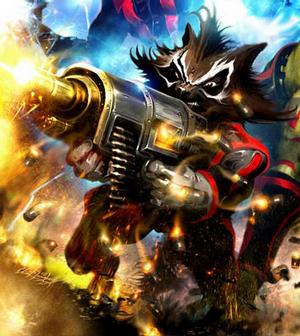
Rocket Racoon; striking the balance between comic relief and diminutive badass. Somehow, it works, but that’s Marvel comics for you
Then, in 2008, Dan Abnett and Andy Lanning came along and re-launched the Guardians of the Galaxy off the back of epic space opera series, Annihilation3. Abnett and Lanning upped the tone of series from space opera romance to cinematic science-fiction. Alien invasions, insidious memes and cosmic conspiracies are the focus of the reboot, and because it’s Abnett, we get some great character interactions. The line up of the team is utterly different; we have Rocket Racoon (an Earth mammal with a rocket launcher), Kroot (a talking, super-strong, regenerating tree-person), Quasar (Marvel’s more likeable version of the Green Lantern) and Starlord, (an experienced soldier who punches far above his weight, a sort of space Batman.) Just as weird as the original, but with the sort of punch modern audiences expect, and much more like The Avengers in Space than the original line-up. It’s a credit to Abnett and Lanning’s skill that these heroes are quite so charming. The new guys keep the romance of the old book whilst keeping it interesting and fun.
Is Guardians of The Galaxy going to do well as a movie? I have no idea. If the movie going audience is willing to buy into super heroes with a sci-fi twist, then probably, but it’s going to take one hell of a good script and a director who can juggle the weird with genuine character drama. I hope they pull it off though, it could be deeply awesome.
1: The Fantastic Four would be the obvious choice, especially as the first two attempts where tosh, mostly because it failed to sell the viewer on the idea of a super hero family. The FF movies aren’t that bad, it’s just that The Incredibles got there first, and did it better.
2: Another example would be The Defenders, who were a hodge podge of heroes you may have heard of; Doctor Strange, Namor, The Hulk and others, especially as it’s a handy way of introducing minor heroes. Sadly The Defenders are bit crap; it’s actually part of their ‘thing’; other super hero teams don’t take them seriously. Sadly, this also meant that neither did comic book buyers. Despite this, they’re fondly remembered.
3: I raved about that series here, but in summary; big space war, things went boom.
Ghostlight
Doctor Who is a very long running show, and one of the questions non-fans often ask is where to start. The answer varies as much as the show does, and when it comes to the “classic”1 show, most die-hard fans will pick their favourite episode starring their favourite Doctor and suggest that. However, no one in their right mind ever suggests Ghostlight. It is, however, a perfect example of what was wonderful and terrible about the Doctor Who in the 80’s.
This brilliant bit of Seventh Doctor fun is notorious for being strange, even for Doctor Who. It’s really trying to be utterly fantastic, and by doing so, falls so very short, though this isn’t the fault of the stars of the show. Sylvester McCoy (as the Doctor) and Sophie Aldred (as his companion, Ace) are always a pleasure to watch – the pair have real chemistry and though this is more obvious in the spin-off media produced years later, it’s apparent in the original. The problem with Ghostlight is that it tries to slam an entire seasons worth of clever sci-fi telly into 90 minutes of dashing around. The result is a confusing and at times terrifying mess.
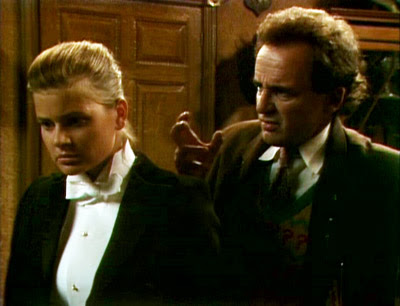
Others remember Ghostlight as the episode where Sophie Aldred wears Gentleman’s Evening Wear. For good reason.
Set in the Victorian era, the plot of Ghostlight revolves around them following themes; Evolution, haunted houses, childhood trauma, dealing with change, coming of age, the advantages of diversity and course, ancient abandoned alien technology. Oh, they added a bit of God in as well, just for spice. All on a budget of tuppence 2. You’ll note I haven’t explained the plot; that’s because it’s so full of surprises it’d be a crime to do so, and also because the plot is so convoluted I’d need a map, flipcharts and glove puppets to explain it all.
It’s a glorious mess. Even the greatest actors in the world couldn’t pull this nonsense off, and though McCoy and Aldred are good, they’re not that good. The sad thing about Ghostlight is that it almost works despite all this; as the show stacks mad idea upon overacting upon another mad idea and then piles on some more really bad effects and wobbly walls, you get the feeling that if the show just calmed down for a second a let you catch up, you might actually have a cracking piece of sci-fi here.
Doctor Who, at its heart, is a show in which one can tell any story. Ghostlight almost breaks this notion. It is worth ploughing through, if you have patience. Otherwise it’s worth watching just to see what classic Who can both at its simultaneous nadir and zenith.
1: Many Who fans will argue that drawing a line between the post-2005 show and the one that ended in the 80’s is bad. I don’t agree – it’s the same show, with the same ideas, but the franchise is so large that distinguishing between ‘new’ and ‘classic’ makes the whole thing easier to navigate.
2: Tuppence – Two pence. I can believe it cost that much. A lot of Doctor Who looks cheap, but at the time, the special effects where pretty good for the day. Except during the McCoy era. It looks cheap because the BBC really didn’t want to spend any money on it.
Prometheus
Fear is one of the greatest challenges that art faces; trying to communicate fear is a difficult task, and fear in and of itself can restrict and strangle an artist in such a way that their work comes out warped. One could cheerfully argue that Hollywood, with its urge to ensure that each and every movie it produces is a blockbuster, is plagued by fear. Fear is also hard to use in art; truly scary movies are rare, and the true spine-chillers are always memorable.
I bring this up because this is the main problem with the movie Prometheus. What starts out as a great film about the nature of man and gods is plagued by having to be part of a legacy of scary movies. By attempting to place itself in the Alien1 mythology, it also attempts to emulate parts of that franchise that fans will enjoy. I have no idea why, but I suspect it’s easier to make a movie if you can strongly link it to other successes.
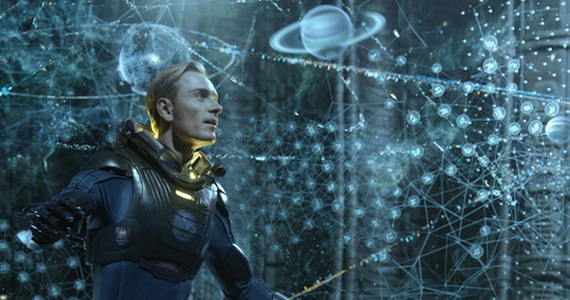
Looks gorgeous, great acting, great idea. If only they had the guts to make it not part of a franchise and go with the promise it gives in the first minutes of the movie.
Sadly, this ruins the feature. It fails to use fear to entertain, and fear of being a failure means the production was attached to something it never needed to be part of. Which is a shame, as the first 40 minutes of Prometheus are near-perfect. Atmosphere is established early on, and a good, old-fashioned tale about mans place amongst the stars is begun2. The sets are gorgeous, the actors are superb, the characters, though plain, seem up to the task of carrying the story and the whole thing looks fantastic. Anyone who grew up with a H. R. Giger poster on their wall will find a lot to love here.
And then, for no good reason, it descends into gore-splatter, knee jerk horror. I am loathe to give out spoilers (so I won’t), but there is one scene which is so trope filled, so cliché ridden that I simply turned off, and it made me feel like I was watching two movies stitched together. I expect Ridley Scott to handle his characters much better than this, and though it’s not as bad as other scenes in the same franchise 3, it brings the movie to a nadir it never quite recovers from.
Throw in a truly dire, CGI heavy scene towards the end and we are left with no surprises and a broken promise. Prometheus should have brought fire to the fearful movie moguls of Hollywood, banishing concerns about clever movies. Instead, it fails, and becomes just another movie about monsters in space.
1: Various people, including the movies producers, have stated that it’s not a prequel to Alien, and they’re right; that would be Alien Versus Predator. The problem is that the movie is hampered by its ties to franchise.
2: One could talk a great deal of horse-hockey about wounds in the side of Promethean giants, the nature of god and all the rest of it. Indeed, this sort of deep examination of the movie is valid, and probably what the director wanted. It’s just that because the last half of the movie is so dire, I cease to care about the clever subtext – make the movie not a pile of pants first, then add in the things that will keep Film Studies teachers in a job for the next 20 years.
3: If you’ve seen Aliens Versus Predator: Requiem you know what I mean.
The Crash of the Elysium
Those of you who are lucky enough to be in the London area over June; The Crash of the Elysium is running from 15th of June to the 8th of July. It’s a Doctor Who themed theatre experience (and yes, I know how that sounds), and you can find booking details here.
I was lucky enough to see/experience it last year, as part of the Manchester International Festival, and I talk about it here, but in short, do go and see it, it’s very good.
Speaking of Manchester based theatre, check out The Greater Manchester Fringe, it has some very interesting events, and it is in its first year.
The Grind
Like many a genre defining movie, Lock, Stock and Two Smoking Barrels has a lot to answer for, because it has inspired not only a huge box of rip-offs, most of them have been terrible. Sad to say, low budget feature The Grind can be added to the list of gritty, London based dramas that promises much but fails to deliver.
It stars Danny John Jules, an extremely fine actor who is best known for his role as The Cat from Red Dwarf, but is one of those incredibly talented types who shines in many roles. If you’re very old, you may remember him from Scum, a much better gritty British b-movie that I was really hoping The Grind would be. It also features actress Zoe Tapper, who should be familiar to fans of Demons1 and Survivors, though she’s almost criminally underused in this. The film’s star is Freddie Connor, who turns in a credible performance as a man who’s in over his head. Connor carries the story as best he can, but it’s clear that there isn’t much to carry.
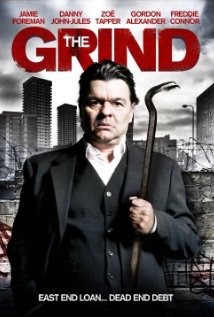
It’s main selling point is “some bloke from Eastenders.” I’m sure the Jamie Foreman fanclub is delighted with The Grind. And by fanclub, I mean his mum.
The Grind is well named; it takes about 90 minutes to tell a half-an-hour tale, and though I’m typically loathe to be overly negative about a small-budget movie, its biggest flaw is that the story isn’t that good. The production is fine (though obviously on a budget) and it has a great supporting cast. It’s just a huge pity that the central premise has been done to death, and adds nothing new to genre.
There’s very little here for any sort of fan; fans of the Danny John Jules are better off watching him in Red Dwarf or maybe Maid Marian and those who love gritty, cockney based dramas have much better things to choose from. There just aren’t enough dans of boring, low budget trash, I suppose.
1: By fans, I mean Stephen Smith in Burnley, and his cat.
Rose Tinted Sci-Fi
So I was rewatching a chunk of Babylon 5 recently, and it struck me how dated the special effects now are; back in the day, Babylon 5 won awards for its starship battles. I shrugged and thought “Ah, but it’s been around since the mid-nineties, I shouldn’t be so harsh”. And then something else, perhaps a clumsy piece of dialogue or poorly realised plot point came up, and immediately, I began to raise the same excuse. It’s at this point, I realised that really old shows (such as, say, 1960’s Doctor Who) have become bullet-proof in the eyes of the fans.
The past, they say, is another country, and by extension, one that’s pretty hard to get to. Unless of course, you’re a geek. We obsessive types love our nostalgia, and the constant reliving of things we enjoyed in our childhoods is part of what it is to be a geek. So we give the old stuff a bit of a free pass.2

The Myrka. It looked rubbish back then. It looks rubbish now. Let’s not pretend it’s age that has made it rubbish, it’s a pantomime horse covered in gunge; it’s totally bobbins.
A show that gets to a level of popularity and notoriety, it becomes a ‘classic’1, and all the flaws that caused it problems when it was new now become funny little quirks of its age3. This is a problem, however. Because in forgiving the flaws, we take something away from the experience.
Take Blake’s 7, for example. Great show, ground breaking. Wonderful ideas, interesting acting, top stuff. Also a show I remember watching from when I was small, so watching it again is like giving sticky sweets to my inner child. However, the production quality dips as the show progresses. It’s a real shame, and you can chart the collapse of show against its mismanagement. Should I give it a free pass then, because it’s old? Or should I get angry because a great idea with an amazing cast got fumbled? By forgiving it for its flaws, I also run the risk of ignoring its depth. I may, for example, decide that an episode which only has two sets was done for budget reasons, rather than the creative challenge.
A good story can be told in any way it needs to. Quality is nice, a super huge budget is lovely, but without a solid story, it will fail. Is the Tom Baker story Ark in Space any less of a great tale about humanity and survival because the monsters are made out of bubble wrap? Does it’s pacing, which was designed for the audience of the time, make it less valid than it is today? Of course not. Let’s enjoy things for what they are and forget terms like nostalgia; good is good, regardless of age.
1: Classic has been long over used, of course,I blame Coca-Cola myself. It’s really just a way of saying ‘old, but don’t let that put you off’. However, because it has the word ‘class’ in it, we assume to also means high quality, as if everything made back in the day is somehow better than now. If that was true, I’d be writing this on my ‘Classic’ BBC Micro Model B computer, or perhaps a ZX81. I’m not, there’s a good reason for that.
2: Which also explains the obsession with time travel.
3: If you don’t get a following though, you’re screwed. Poor Andromeda. Forever judged as Hercules in space. It has a small following, but not enough to give it sort of passionate armour that comes with nostalgia.
Scandal
Has anyone else seen Scandal? It’s an American TV show which seems to be illegitimate lovechild of The West Wing and Hustle. It’s not as good as either, but it could well grow into the role. The show has only turned up recently, mostly to fill in between releases of other shows. The very short first season (7 episodes) implies that the network wasn’t that confident it would work, and I can see why; this is a strange little show, but also gearing up to be a big wodge of fun.
Scandal revolves around former presidential aide Olivia Pope; she and her team of mostly lawyers who don’t practice law but do get things done. They’re sort of like the A-Team, but instead of making a fully functioning air craft carrier out of a battered Ford Fiesta, they instead use a variety of skills to fix things for people who can’t get help in the usual way.1 Clients may be super-rich or super-poor, it doesn’t matter; every week a new challenge. What does the team actually do? They stop people from getting their lives ruined by bad choices. They fight scandals, but in an LA Law sort of way.
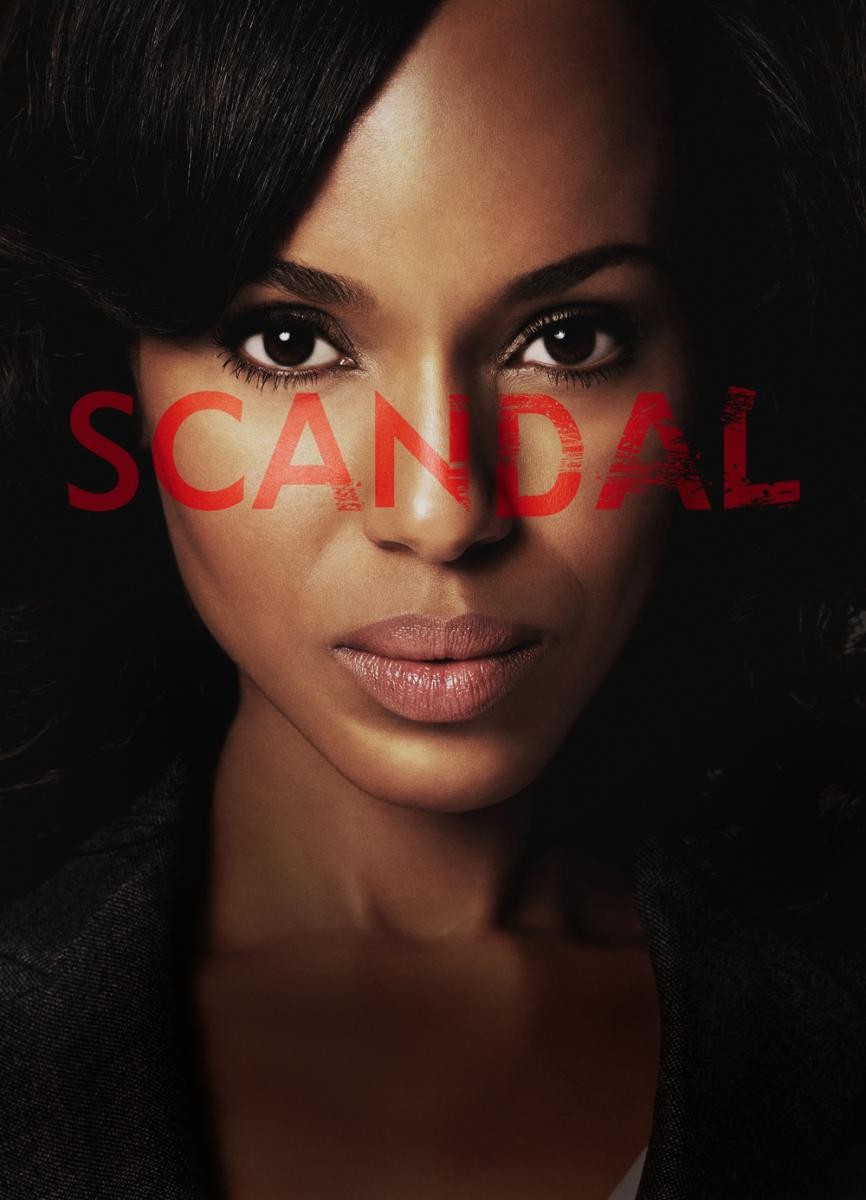
Hard to be subtle when you have the words SCANDAL on your face in big red letters…
Well sort-of. You see, in addition to court-room, law dodging shenanigans, there is also an arc-plot involving the President of the United States, his aides, his ex-lover and this is actually where the show gets a bit interesting; it starts off fine as a series, though a little gutless and pedestrian, when then suddenly, about halfway through, the whole thing dips into real darkness. I like a good poltical conspiracy, and though the show may be biting off more than it can actually chew, it is fun to watch it try.
What began as a ‘scam of the week’1 style show looks like it will quickly shift into something that is actually about the collapse of a government, and possibly a nation. Scandal has the potential to deliversomething rather unique. Let’s hope it does.
1: They couldn’t build an aircraft carrier, but they could certainly get it out of jail if it got arrested for speeding.
2: Similar to monster of the week. Basically, the sort of show where the main draw is the monster, or the heist, or what have you. This is a pretty typical format, though with Scandal, it does just seem to be the minor-plot. It’s almost a bait and switch, though if it does go very weird later on, I may well become hooked.
 Ed Fortune