Far too clever for a Cardinal
History, they tell me, is an excellent source of ideas for storytellers. The more cynical like to say that history is itself an excellent work of fiction.1 When I look at the more recent trend in “Historical” drama, I can see their point. These days, a mere retelling of history is not enough to hold the interest of the general public. It has to have sex and violence in it, and luckily, most history does.
The Borgias2 is a case in point. Historically, The House of Borgia is fascinating. Pick a family member at random and we have reports of murder, fraud, blasphemy, betrayal and all sorts of sex related shenanigans. They also happened to be doing all these things just as the Renaissance was kicking off, so you have interesting people doing interesting things in interesting places during an incredibly important period of history. This pretty much makes The House of Borgia a big shiny jewel in the crown of historical drama.

Lucrezia Borgia, looking nothing like a member of goth band, The Sisters Of Mercy.
It’s rather a pity then, that actual historical fact is a mere footnote; instead the show concentrates on telling a cracking story which is sort-of-true if you squint a bit. Luckily, there’s so much good source material provided by history that it’s almost impossible to do a story about The House of Borgia badly, and The Borgias is well written, directed and cast, though thoroughly over the top.
The plots are fairly Machiavellian, which is spot-on, because this is a show that features Machievelli as a supporting character. Enough attention is paid to history to make it feel authentic without it being a history lesson. If you want to know about 16th Century Italy, read a book. If you want sex, violence, fabulous frocks and an engaging story about power and madness, watch this.
Jeremy Irons is marvellous in his papal splendour, and plays the role of the cunning, clever and quite insane Pope Alexander VI to the hilt, hardly a piece of scenery goes unchewed. The rest of the family are equally marvellous, François Arnaud plays Cesare Borgia as an almost noble yet conflicted man, torn between being a little bit evil and incredibly evil, and Holliday Grainger gives us a demure, slightly naive and yet incredibly deadly Lucrezia Borgia. I am very glad that rather than pitch Lucrezia as a femme fatale from the start, we get a steady run-up to it. The entire first series really does seem to be a prologue for the madness to come, and as history is only given a passing nod, anything could happen. A good start, but one that I hope will improve with subsequent series.
1: A news editor I used to work with used to describe history as “Human interest stories that have stood the test of time”. I sort of like that.
2: I’m talking about the recent 2011 TV series produced by Showtime here. Rather than the 1981 BBC production of the same name, which, if memory serves, suffers from not being as good as I, Claudius. By the way, if you’ve not seen I, Claudius, then you really should.
Let’s stomp some Orks…
The recently launched Onlive Service gave me the opportunity to try out a recently released video game for the princely sum of £1. Being a massive nerd, I chose Relic Entertainment’s Space Marine. Onlive works by live-streaming the game onto your PC, which means you get to play games that use high-end graphics on any sort of PC, provided you’ve got a decent internet connection.1.
Space Marine is a big bucket of fun. It’s not subtle. It’s not going to win awards for clever storytelling, innovative game design or revolutionary insights into First-Person Shooters. What it does do, very well, it let you play a nine-foot tall genetically engineered super-soldier clad in power armour wielding a chain-sword.2 You run round killing Orks in brutal, almost comical ways, and when you’ve killed enough Orks, you pick up a jet-pack and big glowing hammer kill some more Orks.
The game is breath-taking in its simplicity. You shoot the baddies, and when you’ve ran out of bullets, you hit them with some sort of cool melee weapon. It’s brutal. It’s violent. It’s highly entertaining. At the same time, it evokes the grime and futility of the 40K setting; a world where we’ve conquered the stars, yet mankind is trapped in a Dark Ages mentality, surrounded on all sides by hostile forces that want to see the galaxy burn.

Ultramarines; The Manchester United of Space Marines
The plot focuses on Ultramarine Captain Titus, and his two squad mates, given the daunting task of preventing invading Orks from looting the most valuable assets from a world under siege. It comes with a supporting cast of normal, everyday humans (The Imperial Guard) who are mostly there to look strong, brave and die horribly. They also make for the most compelling characters in the game.
Level design is a little dull in places, but as the game is set on planet-sized factory, that’s forgiveable. Still, in the grim darkness of the 41st millennium, people seem to use a lot of lifts. The cut-scenes aren’t terribly intrusive, and exist to not only herd the player toward the fun, but also add to the overall atmosphere. They are a handful of stand-out sequences (particularly one on the train), though it’d be lovely to see more. Dawn of War fans will be pleased to know that they are some nods to that series of games, and lends a consistent feel to the ongoing narrative. Warhammer 40K is at it’s a best when you get a feel for the how incredibly big the setting is.
It’s a fairly short game, taking about eight to ten hours to get through, and it really does feel like it needs a sequel (and much more plot). Still, Space Marine is worth a look, if you like first-person shooters, and definitely worth a look if you like FPS and Warhammer 40K.
1: Onlive works fine as a service. There is a very short wait to get your selected game to load during peak times, and it dropped out on me once during ten hours worth of play. That’s pretty good. My only criticism is that other users can watch you play and vote on how well you’re doing. This is bad, because I suck at video games. However, you can be easily turn off this function, which means I can hide my shame.
2: A chain-sword is a chain-saw sword, obviously. American science-fantasy gives us light-sabres. British science-fantasy gives us chain-swords, which are way cooler by a magnitude by awesome. This is why Warhammer 40K is better than Star Wars. Fact.
The hardest part…
This weekend, I should find out if I’ve been commissioned for some writing work. (It’s not just one thing, it’s a handful of jobs). In any case, I should find out more over the weekend.
I came back to writing professionally because I missed the regular creative challenge, and the validation of being published. I came into to with no illusions as to how hard it was. The reason I write is because it’s part of who I am. The reason I try to get published is because I crave an audience.
What I’d forgotten about was the waiting. The seemingly endless waiting. You work, you sweat, you spend days changing words on a page into something that people want to read, and then you send it out into the world. And wait. And wait some more. It’s not easy.
Rejection, in this case, is almost as good as a commission. A rejection letter means that the people you’ve sent it to have at least acknowledged your existence. This isn’t being needy, this is part of how it all works.
A rejection letter is a sign you’re on the right track, because it’s far more likely that if your work is no good, you’ll simply be ignored. It’s nothing personal, of course, but it never feels like that. It feels like you’ve taken something you’ve created and then sent it out into the world to be eaten by wolves. Novellist and script-writer James Swallow once described the typical response from a publisher as a crushing maw of nothingness, and I agree with him very strongly on this. But of course, it’s nothing personal. And every failure is simply fuel to the marvellous engine called “Being Better”.
So as well as writing, I’m waiting. Patiently. And trying hard not to check my inbox every five minutes.
Confidentially Cancelled
The BBC has announced that this weekend’s episode of Doctor Who Confidential will be the last one ever. The next series of Doctor Who will not have a documentary style companion show with it. Which is fair enough; every Doctor Who fan knows that eventually, all companions have to leave, and this may as well apply to low-budget documentaries as much as it applies to highlanders, savages, future girls and hot redheads.
What’s more interesting is see the reaction of the Who fandom. Sci-fi fans react to the dreaded word “cancellation” in the same way that baby starling reacts to the silhouette of a bird-of-prey; by generating a hell of a din and panicking blindly at the same time. Despite there being no sign of the BBC cancelling its flagship family-friendly drama, the e-petitions1 and twitter hash-tags are out in force. Thanks to the power of the internet, you too can fill the web with sound and fury, and at the same time, signify absolutely nothing.
According to former Doctor Who Producer, Russell T Davies, Confidential started out as a way of squeezing out an additional 45 minutes worth of telly out of a relatively expensive show. After all, pointing a camera at some people and asking them to talk is much cheaper than producing high-quality drama, and the trick was copied elsewhere (Heroes and Merlin, to name but two) as way of making a budget stretch as well as keeping key production staff in employment between filming blocks.

As nice as it is, do we really need another ten hours of this sort of thing?
Things have changed. When Confidential first came out, no one was sure if Doctor Who would be a hit. When it quickly became apparent that the Time Lord and chums was here to stay, plans for a permanent studio were laid and the show saw some heavy investment. As production continued and producers changed, they have learned that the show benefits from being shown in short bursts rather than longer ones, and how to market the whole thing to foreign markets. All things considered, it’s safe to say that we should be enjoying the adventures of a mad man in a box for some years to come. The benefits of Confidential are simply no longer required.
Other factors are worth bearing in mind as well. BBC Three, the home of Doctor Who Confidential, is desperate to cut away the apron strings of the larger, terrestrial channels. Three aims to be the channel you go to watch fresh new telly. It has already cancelled the long running (but awful) Two Pints of Lager and a Packet of Crisps and the axe is falling on various docu-dramas as well. At the same time, new and different shows such as The Fades are appearing on Three, and if this is a sign of things to come, then it is a very good sign.
Still, it’s going to be missed. This year’s series gave us some lovely insights, such as the episode that let us follow writer Neil Gaiman round the set and watch him glow with delight as he got to caper about the set of TARDIS, and it’s always nice to see how things work. However, all these things will still be around, you’ll just have to pay for them when you buy the DVD, and given that we have been spoilt for this sort of thing in the past, you won’t hear me complain. Or sign an e-petition.
1: Ah, the e-petition, the modern way of showing you care without actually having to do anything.
Batman: Brave, Bold and timeless.
Batman is the David Bowie1 of super-hero comics. By which I mean that Batman is constantly re-inventing itself to appeal to a newer generations, whilst maintaining a core appeal and creditability, rather than anything to do with laughing gnomes.
This does mean that Batman has a different sort of appeal to different sorts of people. Some prefer the grim, brooding Batman of the Frank Miller’s The Dark Knight, other’s the tongue in-cheek campiness of the 60’s TV show. Over the years we’ve seen Batman as a cowboy, as an eco-warrior, as a brooding psychopath and as a jolly policeman. Each iteration is instantly recognizable as Batman, but surely, all this identity shifting would make it hard to retell the classic Batman stories?
Not really, as it turns out. The trick is to bring together all these different facets of everyone’s favourite crimefighter into one bundle. To bring a lighter tone but still draw upon the vast wealth of storytelling that come under the label of Batman.

Batman: The Brave and The Bold. Animated in a style that reminds you of 60's comic books.
Batman: The Brave and the Bold squares this circle quite neatly. Not only is full of two-fisted super hero fun, suitable for children of any age, it also uses the full range of the world Batman inhabits to bring rip-roaring stories. The Brave and the Bold prefers to use less well known characters from the DC Universe (the world Batman inhabits), so we get to meet villains such as Kite Man, Eraser and Planet Master as well as the more familiar villains such as Catwoman and The Joker.
Most of the shows work on multiple levels. In addition to excellent animation and some fantastic vocal talent2, the show re-tells classic Batman tales in new ways. Those who are new to Batman won’t notice or care, and most fan-boys will make a little happy sound.
Of course, I’m a sucker for this sort of thing. Without giving too much away, one of the recurring villains in the second series is one of my all time favourites: Starro. For those who don’t recognise the name, I don’t blame you. Starro, a giant starfish from outer space. Sound ridiculous? Maybe, but silly looking things can disarmingly horrible. Starro’s gimmick is to spawn thousands of tiny, face sized starfish that attach to its victims faces, turning them into mindless drones. Sound less silly now? As a child, Starro horrified me. A thing that doesn’t take away your possessions or home, but takes away your sense of self? Scary.3.
So how does this horror fit into what’s essentially family-fare? Very well, and again, on multiple levels. The truly scary ideas keep the adults amused whilst those not reading too deeply into the tale get to see a tale of heroism and two-fisted justice. The result is a show where one week we have Batman battling monsters from a future-gone-wrong one week, and then the following episode having a sing off with Doctor Horrible, Doogie Howser, the Music Meister, without it seeming odd or jarring, which is credit to the show’s producers and the timelessness of the lead character.
1: They are of course, more differences than similarities. As far as I am aware, Batman has never worn a ridiculous blonde wig and a codpiece. At least not yet.
2: Both Kevin Conroy and Diedrich Bader nail the voice for me. Batman has husky yet firm voice, one that is as comfortable telling villains to stop being evil but could also stop a child from eating too many cookies. The ultimate in firm, fatherly voices.
3: At least Zombies get to be dead. Being a mindless drone gives me the heebie-jeebies far more than the body horror of being walking dead.
TROLL!
Trollhunter is a Norwegian movie currently doing the rounds at the sort of cinemas that show sub-titled movies (you know the one, the one you keep meaning to go to more often). The premise is pretty simple; Modern Day Norway has trolls, and has been keeping this a secret from the world. The movie follows a small band of student film-makers who, over the course of the movie, become embroiled in a world much larger, and much scarier than they ever dared to dream.
Trollhunter is, in essence, a classic creature feature. Like all creature features, the focus in on the characters that have their lives affected by the monster’s existence. In this case, that role is filled by Hans, the titular Troll Hunter, brilliantly played by Norwegian satirist Otto Jespergian.
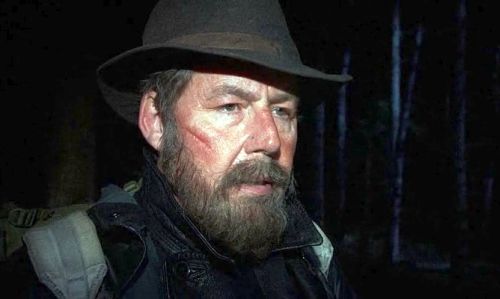
Yes, the Troll Hunter does look a bit like Warren Ellis. Perhaps there's something he's not telling us.
The movie not only explores the implications of giant monster roaming the wild parts of Norway, it also takes it time to have a satirical stab at religion, government and education, but in a subtle way. The main focus is the action, and the entire is shot in a mockumentary shaky-cam style1. This helps us sympathise with the characters a bit more, and lets the viewer buy into the whole idea that Trolls are real and have to be managed in the same way that other wild animals are.
Though darkly comic at times, I do suspect that some of the movie is lost in translation. This is very much a movie that only could have been made in Norway. It’s also great. Engaging, funny and exciting. You should go see it. Even if you don’t like subtitles.
Of course, being a good movie that happens to need subtitles, Hollywood plans a needless remake. (Article here.) I have a problem with this sort of remake anyway2, but in this particularly case, they really are missing the point. This is a movie steeped in Norway, and works so well because it’s a Norwegian movie with local talent, local scenery and local monsters. Introducing an American into the mix would detract from entire affair.
If you haven’t seen it, and you like creature features, go see it. It’s miles better than Cloverfield was, and much more fun.
1: As is traditional for such movies, the movie is allegedly ‘Found Footage’. The Blair Witch Project has a lot to answer for.
2: Partially, I resent the implication that most people won’t read subtitles, and I also hate the fact that Hollywood hoovers up foreign films and remakes them in order to protect it’s market share.
Torchwood – It’s Doctor Who, but mixed up
Torchwood: Miracle Day, finished its fourth season recently. I won’t spoil it for those who haven’t seen it yet, but despite some excellent scenes, I thought it was disappointing.
Torchwood, for the uninitiated, is Doctor Who’s younger, swearier brother. Unlike the family friendly Doctor Who, Torchwood is aimed squarely at the grown-up market, but with the same sort of ‘sci-fi adventure’ flavour that Doctor Who has. The idea is that by aiming a similar show at adults, we can have stories that feature adult themes. Potentially, this could be great. Doctor Who is famous for its wild ideas, and with a license to explore the sort of thing only older people really understand, the potential for rich story telling is great indeed.
The thing is, Doctor Who has had years to hone its trademark streak of insane brilliance. Daleks, for example, look silly, but time and again have been portrayed as horrific monsters to great effect. This is partially because any writer worthy of the name knows Daleks well enough to pitch the terror at a level children can understand. And by doing so, also creeps out anyone who was once a child.

Actually, Torchwood could do with a talking dog. Never did Doctor Who or Scooby Doo any harm.
Torchwood, on the other hand, aims straight at the grown-ups, and misses the mark. The first two series of the show had more bad episodes than good, and the good episodes only served to show us how much potential the idea had. More often than not, we sat down to watch the show expecting an adult-thriller with a sci-fi twist, and instead got something that resembled Scooby-Doo taking itself way to seriously. And the only thing that makes Scooby Doo worth watching is its silliness.
Torchwood’s third series, Children of Earth, however, hit the target dead on. The menace was one that most people could easily relate to, and the show built up a momentum of creepiness, the horrors getting more horrific, the conspiracy getting more labyrinthine, until the inevitable tragic ending. Though not perfect, this was what I expected from the idea of ‘Doctor Who for Grown-Ups’; wild sci-fi ideas, the implications of which grew to be more thrilling (and worrying) simply because I was old enough to understand the implications.
So then onto the fourth series, Miracle Day. Having learned from the previous season, they tried a similar pitch; a simple yet wild idea that allowed the show’s producers to tell a story of conspiracy, of healthcare gone wrong, of the brutality of man’s urge to endure and how redemption is not something that can always be gained through noble sacrifice. Sounds great doesn’t it?
A yet somehow, they missed again. Partially, the tale was too flabby round the sides. Too many episodes, not enough story. It meandered, it took itself too seriously, and it had way to much of the lead actor’s naked bottom in it. Shorter stories can get away with less exposition, and one of Miracle Day’s flaws is that is became a bit of shaggy dog story. We’d waited too long for an explanation, so when it came, it was a disappointment.
They tell me that there may not be a fifth series. If there is, I’ll watch it, but if never comes back, I’m okay with that as well, and that, is not a good sign.
Geek? Me? Of Course I am.
“Speak out with your Geek out” is an online campaign/meme/idea/excuse-to-write-about-cool-stuff/ thing doing the rounds this week. The idea is to talk about the geeky things that you do.
I am relatively un-convinced that geeks need an ‘awareness campaign’ however. Because the modern definition of a geek has changed so much over the years.
30 years ago, to be a geek meant you where someone who did gross things for money. 20 years ago, it meant someone who had poor hygiene and social skills who also happened to have some sort of all consuming hobby or obsession. But the hobby aspect was just icing on the (rather smelly) cake, it was the lack of social skills and the stink that defined a ‘geek’.
These days, when we describe someone as a Geek (or to use the more British version of the term; Anorak) we mean “Someone who spends way too much time on an area of knowledge, often one with no practical use.”

And that’s a pretty broad church. We get Steam Geeks , Car Geeks, Table-Top Gaming Geeks, Video Game Geeks, Vintage Toy Geeks, Anime Geeks, Football Geeks, Art Geeks, Science Geeks, even Geek Geeks. This list is so large, you need to be a Maths Geek to care about how big it is. Fashion Geeks have invented the term ‘Geek Chic’. Ironic t-shirts with obscure references can be found easily (and are used by many as a way to break the ice). Film geeks have filled movies and TV shows with pop culture references. To be a geek is the norm these days.
This makes sense. It’s in our nature to study almost anything to the point of obsession, and that does not have to be a bad thing. Human beings devote their time to a plethora of activities, and to mock someone for having a hobby displays that you have a lack of character. Healthy, happy people have multiple skills, multiple obsessions and do stuff in their spare time.
Do not mock the guy who’s just spent 40+ hours writing an intricate D&D campaign for his 6 friends, mock the idiot who’s spent 40+hours passively sitting on their arse watching whatever happens to be on telly. After all, you wouldn’t mock someone for preferring Coke over Pepsi, so why would you ever mock someone for wanting to play ‘Warhammer 40,000’ rather than watch Eastenders?
The only time Geek gets used as a pejorative term these days is when that obsession gets in the way of said Geek enjoying life. The Manchester United Geek who misses their own daughter’s birth in order to watch the match has a problem, as does the World of Warcraft Obsessive who stays up all night fighting murlocs on the night before that all important job interview. And that’s not an issue caused by being a geek. That’s an issue caused by not being a grown-up. Being a geek is an excuse to celebrate the things that fascinated us when we were young, but it isn’t a reason to not embrace the joys and trials of adult life.
If you like to do something, why aren’t you learning as much about as you can? Being a Geek is to be human.If you aren’t a Geek, what does that make you?
Doctor Dee
Last month, I was lucky enough to catch “Doctor Dee, an English Opera”, as part of the Manchester International Festival. And I have to say, I had a jolly good time. I may as well review it, as it will also be of next year’s Olympic celebrations.
It was a good night out. The production was superb. The set and costumes where as marvellous as you’d expect from a piece set in the Elizabethan era (you’ll believe that the Gloriana can fly), and the music was of the quality you’d expect from Albarn. The actors played their roles with conviction and grace, and everyone who sang had remarkable talent. Many of the key scenes are remarkable and wonderful. (Especially a particularly occult scene which would make any production of The Tempest green with envy) However, it still fell flat in a number of places, simply because, the story of John Dee, as presented, was more tragic than it was compelling.
Dee is a fascinating historical figure, who, though many know the name, few know much about. His biography is a fascinating one, full of conspiracy, scandal, bravery, genius and the occult. So why does John Dee The Opera fail to be exciting?
An amazing production, let down by a story more tragic than it is compelling
Well, partially, it’s because the story the Opera is telling isn’t about Dee, but about the spirituality of England. The production takes pains to take us back in time, to explain to us the way things are in Elizabethan England, and then fails to explore the setting fully. Rather, it asks us to consider how spiritual England is. And frankly, it does this in a pretty half-assed way. One moment it’s asking us why all the churches are empty, the next it’s asking us to witness the fall of a once brilliant man, brought low by hubris.
Apparently, when the opera was in development, they asked Alan Moore to contribute. Moore suggested that they base the opera around Dee, and began work on the project. Predictably, however, Moore threw his toys out the pram during the early stages of the production. Genius he may be, but also infamously difficult to work with. (The full story can be found here.) Moore’s influence can be barely felt on the work, but just a touch seems to be enough here. Too much, and I suspect it would have been inaccessible to the majority of the audience, and as it was, many where scratching their heads.
Is it any good? Yes, it is. The songs are great, the production excellent and Albarn and crew are on top form. But if you’re expecting it to be about one of England finest occult minds, you’ll be disappointed.
The streets of New York look a lot like the streets of Manchester…
Went to see Captain America (The First Avenger) recently, and enjoyed it a fair bit. Of course, I went to see it in 2D1.
It’s a pretty simple tale; Set in World War Two, it follows Steve Rogers, a weedy nerd type who, through the magic of science, becomes superhuman and beats up Nazis.
Such a movie should be pretty hard to mess-up, and luckily, they get the mix just right. The villians are appropiately villianous2, the heroes lantern jawed and heroic. This isn’t a movie where the concepts of ‘heroism’ and ‘good’ are dissected through a complex narrative, this is an action movie about a super-hero who is also a soldier.
One of the core concepts of the Captain America comic book is that the title character is the spirit of the nation; he stands for an idealised form of heroism and hard work, a version of the American Dream that kick your arse if needs be. The movie pulls this off without being too nationalistic or repulsive. This is not “Team America: World Police”, this is the story of a Nazi-bashing, rights-defending dream of America, set in a bygone age.3
If you liked The Rocketeer, you’ll love this. (It’s also by the same director). If you’re a ‘Make Mine Marvel’ type, you’ll make little happy sounds at some of the little references. (There’s a brief glimpse of the 50’s version of the Human Torch, for example. And of course, a SHIELD style flying car.) Go see, if super heroes or fantasy-laden war movies are your thing.
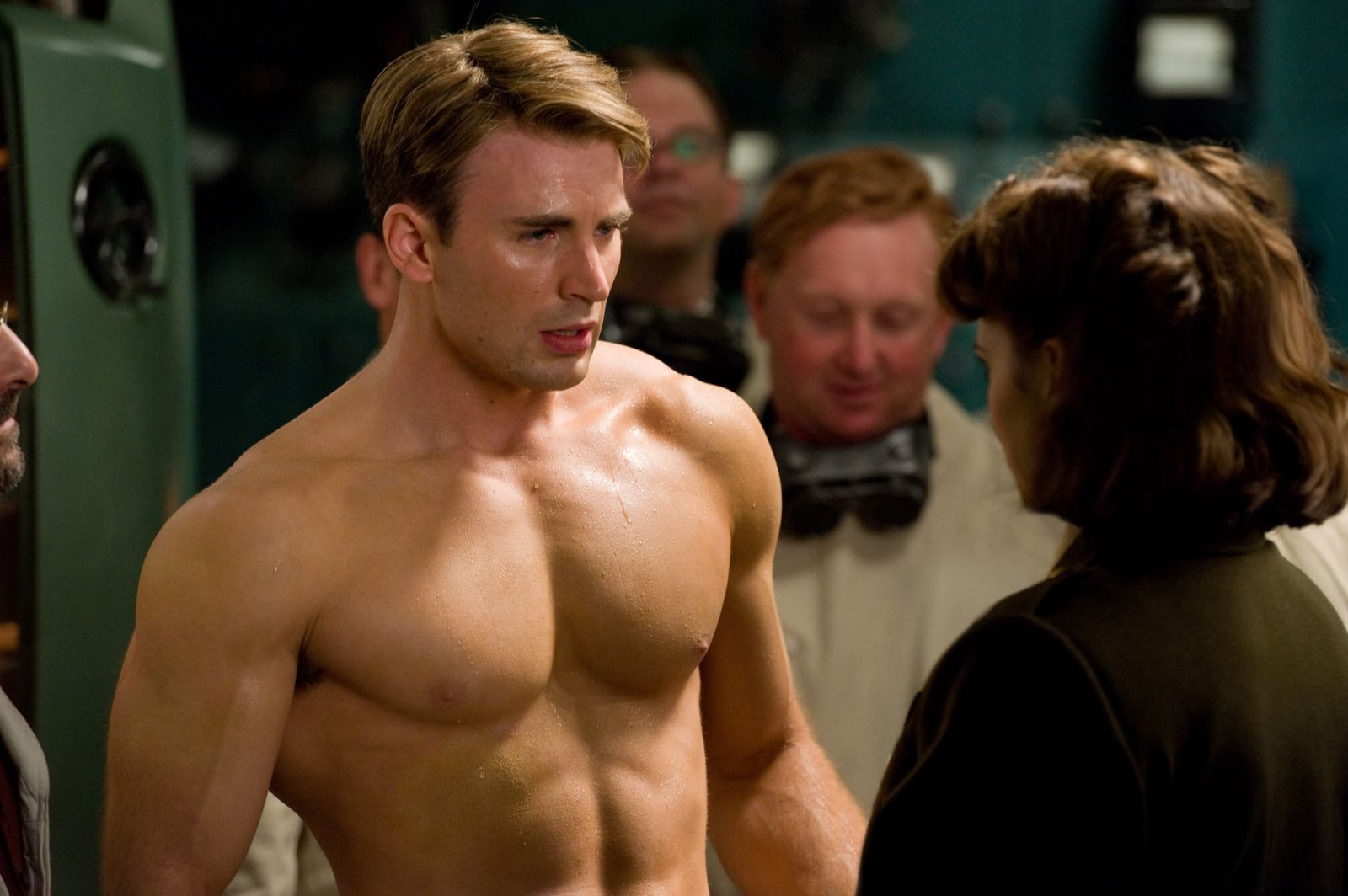
The plot is lean and muscular.
1) 3D is for movies that have no story. Transformers 3 and Avatar, for example, are movies that are more about the spectacle than they are about anything else. You go to watch the explosions. Personally, I avoid that sort of thing as if I wanted to see things go bang, I’d go to a proper fireworks display. The plot tends to be better.
2) It’s nice to see Hugo Weaving and Toby Jones get a chance to chew scenery. Of coure, Jones will always be ‘The Dream Lord’ to me and Weaving will always be Mr Smith, but this just adds to the fun.
3) One of the movie’s flaws is that this theme jars slightly with the movie’s framing mechanism. But not terribly so.
 Ed Fortune