Archive
We’ll Take Manhattan
The BBC has this odd habit of creating excellent drama and then hiding it somewhere in the schedule1 where it will then sink into obscurity and DVD sales. We’ll Take Manhattan was tucked away on BBC 42, and is a bit of a rare gem, being a biographical drama that isn’t afraid to be bold and interesting.
We’ll Take Manhattan follows the early years of now world-famous photographer David Bailey, and goes a long to explaining why he’s such a big deal. It also follows the early years of Bailey’s muse, model and lover Jean Shrimpton, played by Doctor Who companion, Karen Gillan. It’s a fast paced little drama, with absolutely thrilling performances from both Gillan and Aneurin Barnard (who plays Bailey).

Other people to have taken Manhattan include The Muppets
The drama itself is pretty straight forward; Bright young things take on the establishment and win by being energetic, keen and brilliant, though not without some level of personal cost. This may seem like a cliché to us, but the thrust of the drama is that back in 1962, things were less dynamic. Bailey is not portrayed as a rock star, but as a young man desperate to make his mark on the world. Barnard steals the show entirely, and though Gillan is very good (and shows the audience that she is much more than a one-dimensional character), it is Barnard’s depiction of a man who is so hungry to prove himself to the world that he is willing to destroy everything, including himself, to get there.
Another thing that impressed me is how terribly appropiate it all looks; everything but the lead characters look old-fashioned and stiff. (Not just Sixties, but established and ancient). The sets tell the story as much as the actors, the only things with life in them are the shots created by Bailey. The producers have clearly taken great joy in framing as many shots as possible in such a way that they resemble the great photographer’s back catalogue3.
We’ll Take Manhattan can be found on iPlayer, and is worth your time if you have an interest in the Sixties, the history of modern photography or Karen Gillan’s legs.
1: Case in point; Christopher and His Kind, a rather brilliant drama about Christopher Isherwood’s experiences in Germany during the eve of World War 2. Isherwood’s story inspired the musical Cabaret, so you’d have thought it was must see television, especially as it featured a rather striking performance from Matt Smith. I find it odd that the BBC commissioned two Doctor Who actors to do adult dramas, both of which are rather good, and then hide them.
2: The channel for interesting documentaries and semi-factual dramas, formally known as BBC 2.
3: Including the shot with the chain link fence and the teddy bear. You’ll know it when you see it. Though the bear gets abandoned. Karen Gillan’s character keep doing that.
Chico and Rita
To my utter delight, Chico and Rita has been nominated for an Oscar (Best Animation, no less1) which is about time. Given that it’s now available on DVD for about a fiver, I wonder what took them so long, but then the Oscars have never been very good at noticing foreign films.
So why does the Spanish language, animated feature film set in Cuba just before Castro happens deserve an Oscar? Well, probably because it’s one of the most beautifully rendered love stories ever to make it to screen. This is a tale of jazz pianist Chico and talented singer Rita, and how they try and escape their hum-drum lives to create something beautiful. It’s rich and evocative of pre-Castro Cuba, and though it romanticises that period in history, it’s also very blunt about the politics of the time. (Though this is not the focus of the feature).

Apparently, designer Javier Marisca created Rita in a dream. I can believe that.
It’s a tale filled with fiery latin passion, fantastic music (jazz, but don’t let that put you off) and eye-poppingly gorgeous moments. One particular scene practically sizzles on the screen. The characters are drawn in a strongly European comic-book style 2, each character oozing with their key character traits. (Rita drips sex-appeal, Chico is filled with pride and bravado). The art is lovingly detailed and it’s the sort of feature that reveals fresh things on repeated viewings.
Animation is at its most flexible and amazing when it uses the medium to create unique worlds. Chico and Rita exist in an idealised form of the Cuban music scene of the time. Cigar smoke wraps around the singers just so, the pianists are always impeccably dressed and the entire place is filled with beautiful people. At its core though, it’s a movie about what happens when art and passion meet and fall in love.
Spanish speakers will find some of the subtitled translation amusing, as they’ve (thankfully) gone for context-based translation over a more literal interpretation. This is a life affirming, thrilling little feature that I urge everyone to watch. If you find yourself in need of cheering up, I recommend it, though do bring the tissues; it’s as emotional as it is fiery.
1: It’s up against Kung Fu Panda Two and Puss in Boots amongst others. Frankly, those two movies, though nice, pale in comparison to this one. Kung Fu Panda may be all about confidence, and Puss In Boots certainly has a strong hint of passion, but seriously, Chico and Rita is the better work of art, and will dance a bolero around the competition.
2: If you’ve ever read the confusingly titled magazine “Heavy Metal”, you’ll know what I mean. Self Made Hero do produce a comic book version of Chico and Rita as well, and it’s worth your time; what it lacks in movement and music it makes up in artwork.
Ninja Terminator
The names of some directors are an almost certain guarantee of quality. The mention of Spielberg, Miyazaki or Scorsese can be all one needs to sell a film. Likewise, a few names guarantee that a movie will be awful, and yet still entertaining. Ed Wood, Joe Da’mato, Uwe Boll and of course, the master of the terrible chop-socky movie, Godfrey Ho.
Ho is best known for Ninja Terminator, for several reasons: Firstly, it’s his worst movie, which of course, given that he’s valued for being terrible, means that it’s the one most people like to ridicule, second, it’s actually several aborted movies spliced together (so the plot makes no sense) and thirdly, it takes some of the finest actor/martial artists of the time and utterly misuses them.
For example, Korean martial arts expert Hwang Jang Lee, an actor so iconic within his genre that martial arts homage Kill Bill repeatedly references his work, spends the entire film in a bright yellow goldilocks wig, for no discernible reason. Jack Lam, an actor known for his legs, spends of most of the movie driving a car, and Richard Harrison1, the actor who famously handed Clint Eastwood his career, cites Godfrey Ho’s movies (and this one in particular) as the main reason he retired from cinema.

This man is 7th Dan martial artist. I wouldn't mention how bad that wig is.
More jarringly, not only is this two failed movies re-edited to make a single failure, but the movies were shot 10 years apart from each other. On different film stock. In different locations. Ho cunningly stitches the two movie plots together through the use of a novelty Garfield telephone and a battery operated toy robot. 2
The plot, such as it is, features the efforts of good ninjas trying to take down the Ninja Empire, through the use of a magical statue. Or something. Frankly, important parts of my brain began to shut down round about twenty-minutes in when crabs turned up for no apparent reason.
In short, Ninja Terminator is everything you’d expect from a movie with a name like Ninja Terminator, and it will delight connoisseurs of crap. Fans may be interested to learn that there is another Ho movie called Ninja Protector. It’s not a sequel, but it has the same actors. And some of the same scenes.
1: If you have no idea what he looks like, imagine a weaponised version of cricket commentator Des Lynam. With a more terrifying mustache.
2: Sadly, Ho is not a secret master of the subtle and the surreal. He just happens to own a Garfield telephone.
In defence of Stargate: Universe
Stargate:SG1 is, in many ways, the closest America has come to producing a show with the depth and joy of Doctor Who. Though very different, both shows enjoyed a flexible format that required the lead characters to investigate and explore new things. In keeping with an established formula for TV shows, SG1 was responsible for two spin-offs Stargate:Atlantis and Stargate:Universe.
Atlantis stuck to a formula established by the original show; an over-arching race of baddies, a reason to go to a different planet every week and political shenanigans threatening to destroy all the good work of the heroes. The main deviation from the original show seemingly happened by mistake. You see, the stars of the show where meant to be the ruggedly handsome Colonel, the Whiny Nerd and two interchangeable Combat-Wombats1.
The actual stars turned out to by the Whiny Nerd and his sarcastic chum.2. So when it came to Stargate:Universe, they’d learned the lesson that square-jawed action heroes don’t always equal interesting. Universe is filled with flawed characters, so much so that the entire premise of the show was based around the consequences of having the wrong people in the right place at the right time.
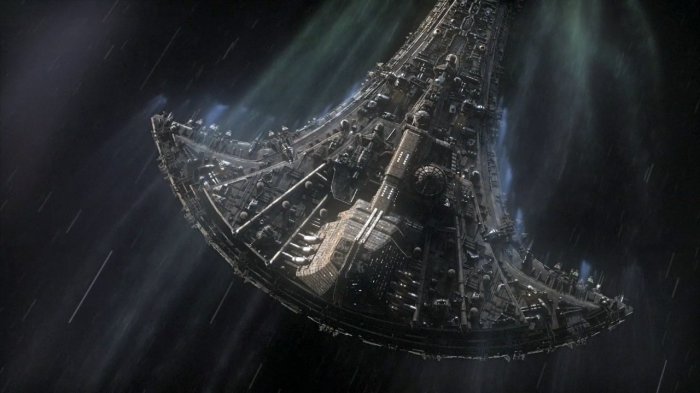
I also loved the design classic sci-fi feel to the set design.
Unlike the previous two shows, Universe exiled its cast from the any sort of support, and distanced itself from decade’s worth of mythology.
And you know what? It really worked. Every show was filled with internal conflict. It didn’t really matter what monster of the week threatened the heroes in any give episode, because we tuned in to find out what was happening to the characters. Would the young, naive genius with a low self-image finally find his self-esteem and maybe love? Would everyone realise that the go-get-‘em jock type was actually a bit of jerk? Would I ever stop thinking that Robert Carlysle’s character was nothing more than Trainspotting’s Begbie in a tweed jacket?
A lot of the fans hated it, and I can see why. The first two Stargate shows are all about luck and optimism. One can take on city hall and win (and by city hall I mean a vast army of intergalactic warlords). Science and romance tends to win out, though a little brute force tends to help out. Universe had utterly different themes; cynicism and struggle where the order of the day, problems would not go away once someone had shouted “SCIENCE!” at it and the conflict was almost always internal, rather than some horrid threat from beyond the stars. Which made for great television, but after 10+ years of seeing Stargate Command take on gods and win, I can see why fans were disappointed. They wanted bright heroic romance, not dark struggle.
Which is a pity, because the show was all about triumphing over the impossible. Universe also suffered from being compared to the new Battlestar Galactica, which, despite stylistic similarities, it really was nothing like. It had arch-plots, an established setting, and was clearly designed to run for a long time, whereas Battlestar Galactica suffered from being a mini-series that went on too long.
Sad to say, Stargate:Universe got cancelled before we really gave it a chance to get going, and joins the long line of sci-fi TV shows that could have been a contender, if it had only been given a chance.
1: Sadly, not actual wombats. Actual wombats would be more interesting. Especially if they had guns.
2: Rodney and Zelenka; the great unfinished bro-mance story. If they had their own show I’d watch the shit out of it. Seriously, natural chemistry, comic-timing and sarcastic science speak? Awesome.
Sherlock
Sherlock, for those of you haven’t been paying attention, is the BBC’s latest take on Sir Arthur Conan Doyle’s Adventures of Sherlock Holmes. Set in the modern day, it re-casts the iconic British crime-fighting duo, with Holmes as a high-functioning-sociopath and Watson as a war-veteran turned blogger (Rather than the classic Gentleman Detective and bumbling doctor friend that has become the cliché.)
Each episode is a 90-minute mini movie and is at its best when it reworks classic Sherlock Holmes stories with a modern twist. Every show is laced with references to original works1, and all are clearly labours of love. Though the individual cases are intricate as well as interesting, and even though the weakest episodes have a strong detective story at their core, the show is actually about the relationship between a genius and the rest of the world.
There is a certain amount of cross-over appeal between Doctor Who and Sherlock. Though this is, in part, because Steven Moffat is involved in both, I’d like to think that it’s more to do with it being character-centred adventure drama. Both shows centre on a brilliant person who can perform miraculous feats of mental agility and yet has difficulty relating to other people, and though they are set in entirely different worlds with utterly different legacies and goals2 it is the lure of the brilliant maniac that compels us to keep watching.
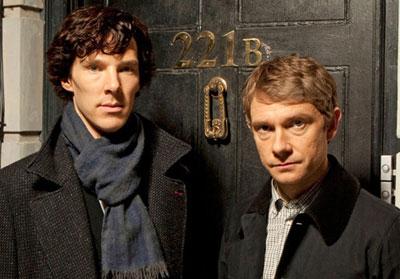
Smaug and Bilbo Baggins, together at last
The true genius of Sherlock is the way it draws on the wealth of history surrounding the stories to create a unique tale every time. Though the show misses the mark on occasion3 , it avoids formula. Sherlock will never be a genius centred procedural drama such as House (which is also a re-imagining of Conan Doyles famous creation).
My only criticism is the fact that we only have a limited number of Sherlock stories left. The two main actors are now both much sought after by Hollywood and the shows producers are also involved with big budget projects. This is actually a good thing; like Fawlty Towers and The Prisoner it will stay on our screens long enough to enter the hall of fame. And quite right too.
1: So many references and nods, in fact, that you could probably write many scholarly papers on it. The love and care devoted to show is right there on the screen. The producers love the fans, and the fans love them right back. There’s even a shout-out to the fanfic community, if you know where to look.
2: For example, Sherlock’s cynicism has no place in Doctor Who . The Timelord’s adventures are romantic and impossible, whereas Sherlock goes out of its way to place us slap bang in reality. We can almost taste the smog and sweat that is unique to modern London.
3: The episode The Blind Banker is noted by many of the fans as the weakest episode. It isn’t weak, it just draws upon source material that is not as interesting as it once was.
The adventure-game magazines of the Eighties
Back in the mid-eighties, Fighting Fantasy1 books where everywhere; young geeks devoured them, and the bookshops where filled with a myriad of titles and their imitators. For the dedicated fan though, this wasn’t enough. The books painted a fantasy world, but the fans wanted more.
Cue Warlock, the short-lived Fighting Fantasy Magazine. For a fraction of the cost of one of the books, you could get a brief fix of your growing gaming habit. Better yet, you got to glimpse the development of these worlds. Warlock, featured maps, articles and monster profiles, and was pretty much a basic primer on how to build worlds. Many of these features would later be further developed into source books for Fighting Fantasy’s main setting. What made it stand out from the other fantasy gaming magazines of the era was the sense that things where being created before your eyes.
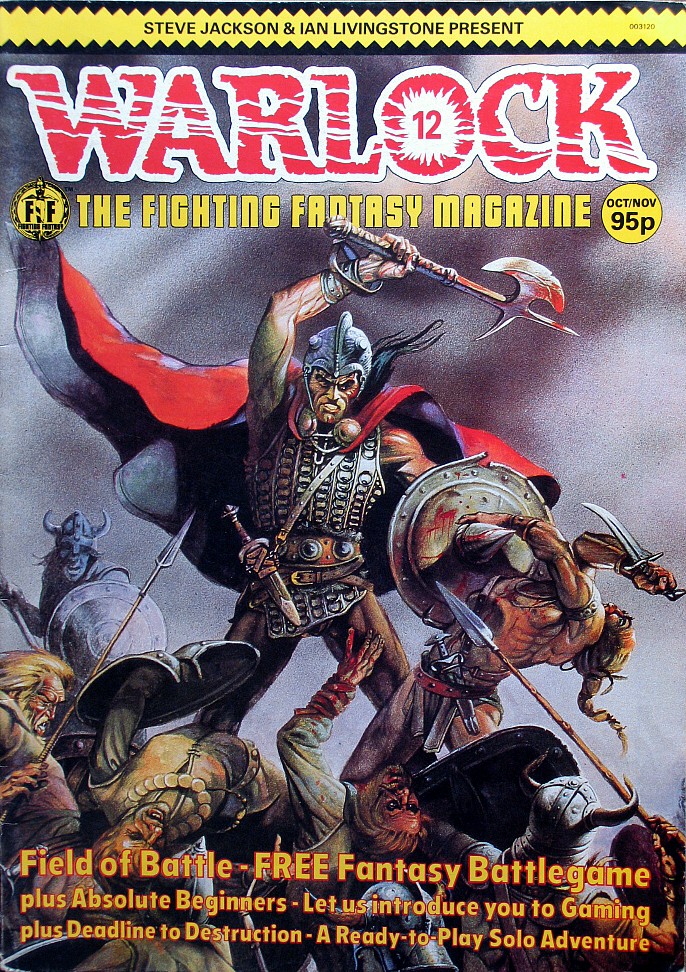
Smell the nostalgia. (Though it could just be the smell of old magazines.)
That and the mini-adventure stories. If you can have adventure books, then surely you can have adventure short-stories, and the idea that one can delve into a spot of gaming on a short bus trip has always appealed to me. I find that adventure books tend to be single sitting affairs, I open the book and try and finish it in one gulp. I may come back to it later to play other options, but if it’s any good then it should feel more like a thrilling fairground ride than watching a TV series.
The cool thing about short-form adventure games is that you can indulge and then leave them alone. They’re quick, fun and pretty much ideal for wasting time in those short moments. Even though the old Fighting Fantasy novels are now available as apps,2, I‘ve not seen short-story format adventures in the modern formats. Which is sad, as the appeal of the e-books is their portability. This is why I tend to read short stories on the train, after all. I’d much rather delve into a sword and sorcery game than play Angry Birds, especially when I’m in the mood for something a bit more interactive than a regular book, but I also want it to last the length of my journey and no longer.
Warlock, by the way, only lasted for 12 13 issues, but in that time developed two imitators. Proteus was filled with the contributions from fans, and some of these were very good. It was all about the adventure-game aspect, and lasted a little bit longer than Warlock. Also of note is the sadly very short-lived Dice Man. Edited by 2000AD legend Pat Mills, Dice Man was an adventure game anthology that let you play the characters form the 2000AD comic. The stories where told through comic panels, and this quirky little bit of comic book history was recently paid homage to in 2000AD’s Prog 2012 with a fun little Judge Dredd story.
I do wonder if this sort of thing will make a come-back. We have the technology, after all, and I recently discovered they’re as fun to write as they are to read. It would be nice, and I do get the feeling that they are due a glorious come-back. Time will tell.
1: Adventure Game books require the reader to make choices, rather than passively reading the story. All books draw you into a different world, but only Adventure Game books let you hit things once you’re in that world.
2: There is also a new generation of these games such as Jonathan Green’s Temple of The Spider God, exclusive to iPhone. Hopefully you’ll be able to read them on other things soon enough.
Empire State
Super hero stories tend to shine when they’re dipped in noir-style nostalgia; both genres lend themselves to tales of two-fisted fisted, and the grime and dirt of the post-war era balances nicely with heroism and rocket powered justice. So it should come as no surprise that Adam Christopher’s debut novel Empire State, a tale of rocket powered heroes and private detectives during the American prohibition, is pretty good stuff.
Empire State is the tale of two cities; one is New York in the 1950’s, the other is a mirror-universe version of the Big Apple, called The Empire State. Whereas New York is a big place, filled with possibilities, The Empire State is a claustrophobic, insular city at war with a shadowy foe. The story follows the life of Private Detective Rad Bradbury1, a good man in a rotten city.
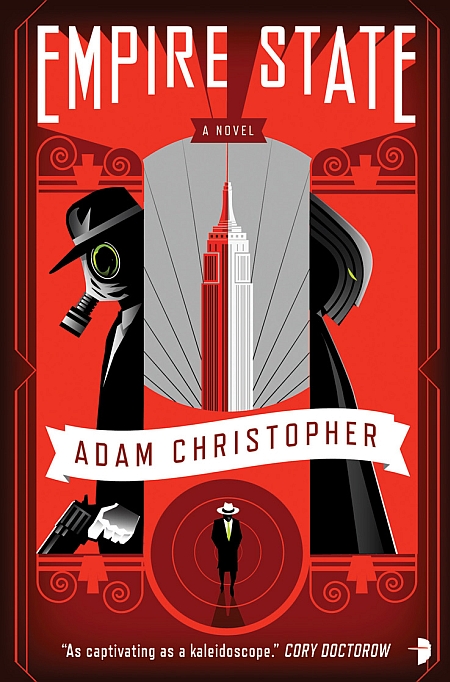
Gas Masks, Rocket Packs and Zepplins. What's not to love?
As you’d expect, there’s a woman with a secret and a missing person to find. There’s also rocket powered heroes, super villains, robots, airships and dashing captains. It’s a skilful blend of two well-loved genres, and it’s a fun, pulpy, tightly written book.
The setting is not just an interesting backdrop; the author takes full advantage of the premise and fills in a lot of the details in way that keeps luring you. This makes for a dense story with a well realised world behind it. Like you’d expect in any good mystery story, every character has a past and a strange secret. These elements slowly fit together to create a world greater than the sum of its parts.
Empire State is a master class in world building, whilst still retaining a coherent and engaging story. It manages to keep the reader guessing all the way through, without losing itself in its own mythology.
Fans of Kurt Busiek’s Astro City , movies such a Sky Captain and the World of Tommorow and the The Rocketeer or any ‘Dark Mirror’ episode of Star Trek, this one is for you. Fan of pulp adventures and twisty, noir-style plots will find a lot to love here.
1: Oh yeah, and it’s full of lovely little references like that as well.
Verity Fair – Terry Wiley’s latest book
Way back in the early 90’s, UK independent comics seemed to be the next big thing, and there was a seemingly endless supply of new and trendy graphic novels. Most were very different from the mainstream, telling odd little stories about real things in unreal places, rather than the usual action-adventure hero fair. Sadly, the big British indie comic rush never really happened, and though a few creators moved onto bigger things, many more simply vanished, and many great stories just petered out, never to be finished.
So I was recently delighted to discover that comic book creator Terry Wiley is back. Wiley is perhaps best known “More Tales from Sleaze Castle”, a strange tale that puts an ordinary person in a surreal and extraordinary world (imagine Hitchhikers Guide to the Galaxy with a more surreal bent, and add an aardvark.) 1. Wiley’s latest work is called Verity Fair, and focuses on the everyday adventures of Verity Bourneville, a 40-something jobbing actress.

Great art mixed in with photo backgrounds lends a strong real world feel to the work
She’s had a good life, but one that has had more than its fair share of strange moments and quiet horror. Verity Fair, is an everyday tale, filled with humour, tragedy and well realised art. Though they are plenty of shout-outs to Wiley’s previous work, knowledge of obscure 90’s indie comics is not required.
I can firmly say that this is Terry’s best work so far; the art is strong, the characters are interesting and the plot, though slow, is fun and clever. The tale of one women’s journey through a tough world is never going to fly off the shelves; comic book fans aren’t famed for their love of domestic drama, which is a real shame as it means they’ll miss out on a great read.
Fans of the TV series Coupling , or those who just appreciate good pub inspired banter will probably get a kick of Verity Fair. Further samples of Wiley’s work can be found here and Verity Fair is currently available by bothering your local comic book dealer and getting him to stock it for you2.
1: The book generated a series of spin-offs: the everyday mystery story (and prequel) “Tales from Sleaze Castle” and the conspiracy theory parody “Surreal School Stories”. The latter was presented in a penny dreadful format, mostly text with key illustrations, with the occasional full length comic-strips appearing elsewhere. (For a good example, take a look here.) You may also want to check out Petra etc.
2: Travelling Man UK would probably be your best bet; the Newcastle store certainly has copies.
The Ballad of Halo Jones, The Stage Play
Manchester based pub and venue The Lass O’Gowrie is often on the cutting edge of nerd-cool, and plays host to a wide variety of geek friendly events1, so it was the natural venue of choice for the debut stage production of The Ballad of Halo Jones.
Halo Jones is a much-loved science fiction comic strip by notorious Northampton genius Alan Moore, and is famous for its epic, inter-galactic feel, domestic storyline, and social commentary. So adapting it into a stage-play was always going to be a feat, especially one designed for a small, intimate venue.
The limited space and obvious shoe-string budget have been skilfully turned into an advantage by the production company Scytheplays. A tale that takes us from the depths of a futuristic slum to the heights of space could easily have been achieved given a lavish budget, but is instead portrayed far more effectively through inspired acting and clever verbal cues in the script.

"Where did she go? Out. What did she do? Everything."
The actors are brilliantly cast. Those of you who fell in love with Halo in the pages of 2000AD should be prepared to be equally enchanted by Louise Hamer’s performance. Benjamin Patterson tackles the difficult task of playing the menacing robot dog2 Toby with great skill and care and clearly is having a ball doing so. For me, the most stand-out performance is by Danny Wallace, who plays the doomed, hopeless and sexless creature, The Glyph. It’s a role that requires comic timing, empathy and a gentle touch, and Wallace is perfect throughout.
The script strips the story down into two acts, each about an hour long and covers the first two books3. Fans of the original will be pleased to learn that no major changes to the storyline have been made, and the odder characters (Rats, Dolphins and TV newscasters) are handled in a believable sort of way. Those who’ve never read the book should brace themselves for strange future-speak and a bizarre, yet socially relevant story. The future-shock will pass as the play goes on, but I suspect the social commentary will stay with you.
The Ballad of Halo Jones is as important now as it was when it was first written in 1984, and is a tale that deserves to be heard by a wider audience. If you’re lucky enough to live in Manchester, and have a spare evening, do go and see the show.
1: “The Lass” has vintage video game nights, Doctor Who themed evenings and has played host to the likes of Professor Elemental and Mr B, The Gentleman Rhymer. If you’re lucky enough to live in Manchester, you should take advantage of The Lass.
2: In the graphic novel, Toby is a beautifully drawn robot dog. In the stage-play, they have more obvious limitations, and handle it through a carefully thought out interpretation of the source material. It also helps for Patterson’s performance is spot on.
3: The original work is in three books, the third being a strange, starship troopers style space war. It’d be hard to do well on the stage, and they wisely avoid it. This doesn’t detract from the production at all, especially when you consider that the original book was never properly finished.
Webcomic Roundup 2011
The internet is a fantastic tool for procrastination, and my preferred way to waste time is to browse the seemingly unlimited number of webcomics. Here’s a quick look at some (but not all) of the sites that have distracted me the most over 2011.
Dresden Codak is stunningly drawn with a seemingly vast and intelligent story at its heart. They aren’t many tales about a world overtaken by scientific dogma and the consequences of the singularity. It suffers slightly from the lead character being more interesting than the story. Needs to update more often, however.
Girl Genius on the other hand, also looks lovely and is updated three times a week. The ongoing story continues to twist and turn, and is epic in scale. The world, one of steampunk, mystery and monsters, and is lovingly described throughout the comic. It often suffers from being a graphic novel in serial format, and actually works better in paper format than on the screen. (I’ve got some of the paper and ink versions, they’re very nice.)
Gutters, Least I Could Do and Looking For Group are all ongoing projects by one Mr Ryan Somer. Least I Could Do is essentially a raunchy sit-com, and despite being one very
long cock joke, is never the less quite entertaining, though I do wonder about it’s long-term stamina. Looking For Group is an ongoing fantasy story (like Girl Genius or Goblins), with a stronger focus on humour rather than adventure. Gutters is the more interesting of
the three; it’s a series of one-shot gags about the comic industry, and is hilarious to the right sort of nerd. Somer has apparently received a few cease and desist letters about it, so he’s clearly annoying the sort of people he’s set out to annoy, whilst delivering the funny.
Myth versus Superscience tale Gunnerkrigg Court continues to ramble along at its usual pace, and this is its biggest problem. I’m not sure where it’s going, and I’m not entirely sure I care anymore.
Luke SURL is a regular gag comic which never fails to make me laugh or groan. I’m a sucker for puns, and for silly little flaws in narrative logic. Addictive, though something to binge on rather than read regularly.
Scenes from A Multiverse does what it says on the tin. It’s a surreal series of flights of fancy that never fails to entertain, and is far superior to the artist’s previous project, Goats. In many ways, it’s Goats without poorly thought out plot-arcs, and that suits me just fine.
Questionable Content continues to be a long, tedious sit-com with talking robots in it. It’s never been as funny as Diesel Sweeties, and yet I’m more likely to come
back to come back to QC time and again, because it’s so easy to pick up and get into.
XKCD continues to be fairly hit and miss. Randy’s best gags are those based on his personal experiences; heartwarming gags, often bitter-sweet. The strip is at its worst when it’s being clever for the sake of being clever, rather than yelling “Isn’t science awesome”. I can’t shake the feeling that XKCD is in slow decline, which is a pity, because when the author is celebrating romance, mathematics and language, it’s rather wonderful.
Finally, Zebra Girl has finally found it’s groove by dipping into the surreal and dreamlike. Which is good, because it never fails to be interesting, even at its most self-indulgent.
 Ed Fortune